

Key Takeaways
- AI for performance reviews works best when it supports manager judgment, not when it replaces it.
- The most effective uses of AI in performance reviews are drafting feedback, roleplaying review conversations, and evaluating written reviews for clarity and fairness.
- Well-designed AI tools adapt to manager experience levels, offering guidance, rehearsal, or evaluation depending on need.
Performance reviews are one of those manager responsibilities that carry outsized anxiety. They matter a lot. They’re personal. And they’re rarely taught well.
New managers worry about saying the wrong thing. Experienced managers worry about saying the right thing the wrong way. And everyone worries about whether the conversation actually helps the employee grow.
This is exactly where AI for performance reviews can help—if it’s used as support, not a substitute. Used thoughtfully, AI can help managers prepare clearer, more balanced feedback, practice tricky moments in advance, and spot gaps in tone or fairness before the conversation happens.
Quick Answer: What does “AI for performance reviews” actually mean?
AI can help you prepare for performance reviews by turning scattered notes into a structured summary, generating a draft you can edit, and letting you practice the conversation before it happens. The most effective approach is to use AI for organization + wording + rehearsal, then apply human judgment for accuracy, nuance, and coaching intent, especially for sensitive or high-stakes feedback.
That balance matters: research shows most employees are open to AI-assisted performance reviews when managers remain responsible for reviewing and refining the feedback.
At Intrepid, we’ve been experimenting with how AI-powered learning experiences can support people at different skill levels, with different needs, at different moments. One example is an AI Activity designed specifically to help managers prepare for performance reviews.
The key idea: AI shouldn’t replace your judgment, it should support it. Here’s how the activity works.
One AI Activity to Help With Performance Reviews. Three Paths for Manager Preparation.
Not all managers need the same kind of help when preparing performance reviews. So instead of a one-size-fits-all experience, this AI performance reviews activity offers three distinct modes, depending on experience level and goals.
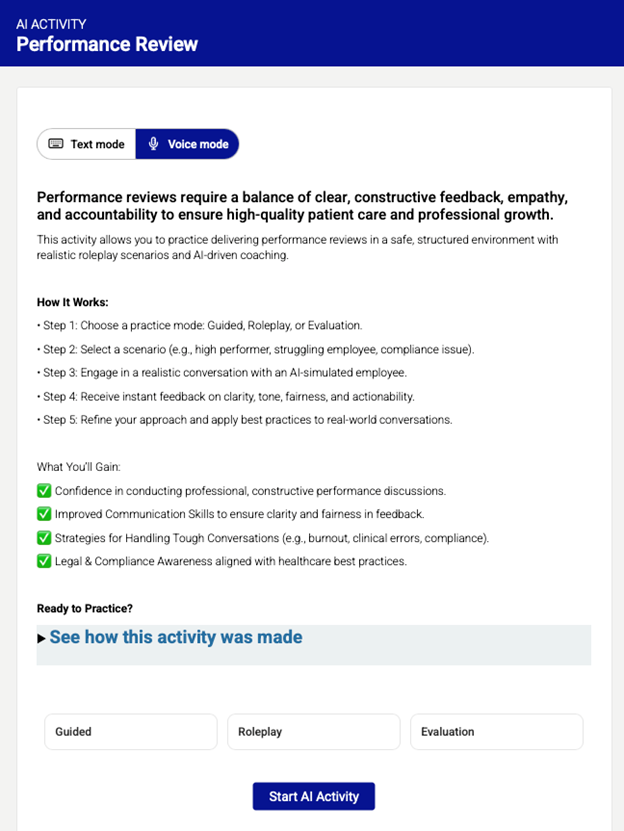
1. “Guided” AI for Writing Performance Reviews — For New Managers Who Need a Starting Point
If you’ve never written a performance review before, staring at a blank page can feel brutal.
In Guide Me mode, the AI walks you through how to write a performance review step-by-step. Rather than dumping generic advice on you, it asks targeted questions about:
- The employee’s role and responsibilities
- Their strengths and growth areas
- Recent accomplishments and development opportunities
- Challenges or patterns you’ve noticed
As you answer, the AI helps structure your thinking and translate it into clear, balanced feedback. By the end of the activity, you don’t just understand how to write a review, you have a draft performance review in hand that you can refine.
This is scaffolding, not shortcuts. You’re still doing the thinking; the AI helps you organize and articulate it.
2. “Roleplay” AI for Performance Review Conversations — Practice Before It Counts
Writing the review is only half the challenge. The real pressure shows up in the conversation.
With Roleplay mode, you can practice delivering performance review feedback in a safe, low-stakes environment. The AI takes on the role of the employee, responding realistically based on what you say.
Along the way, the AI can:
- Coach you in real time
- Help you reflect on tone, clarity, and empathy
- Adapt the conversation based on your responses
You can replay the scenario as many times as you want, and each practice run adjusts based on your choices.
At the end of each session, you receive:
- A clear score
- Actionable coaching feedback
- A consolidated view of what went well and what to improve
This kind of AI-supported rehearsal helps managers build confidence before real performance review conversations without risk to trust or relationships.
3. Performance Review AI “Evaluation” — An Extra Set of Eyes for Experienced Managers
If you’re an experienced manager, you may not need help writing reviews or having the conversation, but that doesn’t mean feedback wouldn’t help.
In Evaluation mode, you can upload or paste a performance review you’ve already written. The AI evaluates it against:
- Your company’s goals and priorities
- The intended review structure
- Best practices for clarity, fairness, and impact
Instead of generic tips, you get context-aware feedback that highlights vague language, tone issues, or missing evidence.
Think of it as a sharp, objective second opinion that respects your experience.
Why AI for Performance Reviews Works Best as a Learning Tool
This is the bigger point.
AI has the opportunity to unlock new learning experiences at every level, for almost any challenge. But only if you’re intentional about designing with AI.
At Intrepid, our focus isn’t on adding AI for novelty. It’s on integrating AI into learning experiences in ways that:
- Support real work
- Adapt to learner needs and experience levels
- Drive meaningful behavior change
Performance reviews are a perfect example. They’re complex, human, and consequential—and that’s exactly where AI can be most powerful when used well.
Not to replace managers. But to help them show up better.
Curious how AI Activities like this could support managers or learners in your organization? Let’s talk.
FAQ: AI for Performance Reviews
Can AI write performance reviews for managers?
AI can help draft performance review language, but managers should not rely on AI to produce a final version without human review and edits. The best use is generating a starting draft from structured inputs (goals, outcomes, examples), then adjusting for accuracy, context, and coaching intent.
What are the best ways to use AI for performance reviews?
The most practical uses are:
- Drafting and rewriting feedback for clarity and balance,
- Roleplaying the conversation to practice tone and responses, and
- Evaluating a draft review to spot vagueness, missing evidence, or tone issues.
Is it ethical to use AI for performance reviews?
Yes, when AI is used as a support tool and not a decision-maker. Ethical use requires transparency, human oversight, and safeguards against bias. Managers should always review, adjust, and own the final feedback.
How do you use AI in performance reviews without introducing bias?
Use AI to check for bias rather than to decide outcomes. Keep inputs fact-based (specific examples, measurable outcomes, agreed goals). Review outputs for gendered language, personality judgments, or uneven standards and ensure the feedback aligns with role expectations.
What should you avoid putting into AI tools during performance review prep?
Avoid personally sensitive information, confidential HR details, medical information, protected-class characteristics, and anything you wouldn’t want stored or logged. When possible, use approved enterprise tools and anonymize details (e.g., role level instead of names).
Can AI replace managers in performance reviews?
No. AI cannot replace human judgment, context, or empathy. It can reduce administrative burden and improve consistency, but performance reviews remain a fundamentally human responsibility.
What are the risks of using AI in performance reviews?
Common risks include over-reliance on AI output, bias in training data, and loss of trust if employees feel feedback isn’t genuinely human. These risks are mitigated when AI is used for preparation, not automation.
What’s the best way to start using AI for performance reviews?
Start with low-risk use cases: guided drafting, conversation rehearsal, or feedback evaluation. Avoid fully automated reviews and ensure managers understand AI’s role as a learning and preparation aid.
What prompts work best for AI-assisted performance reviews?
Prompts work best when you provide structure: role expectations, goals, specific examples, and the tone you want. For example: “Using these achievements and challenges, draft balanced feedback with specific examples, and include 2 growth suggestions tied to role competencies.”
Will employees trust feedback if they think AI helped write it?
Trust usually comes from specificity, fairness, and manager ownership. If AI support leads to clearer and more actionable feedback, and the manager can explain and stand behind it, trust tends to be higher than if feedback sounds generic or disconnected from real work.