
Carnegie Learning expanded its portfolio of professional learning experiences by introducing a scalable learning pathway that combines structured collaboration, coaching, real-time classroom application, and research-based design to drive meaningful changes in teaching practice. Through its Patterns® program, built on Intrepid, educators engage in continuous learning cycles that connect professional learning directly to classroom implementation and ongoing reflection.
Challenge: Scaling What Works Without Losing What Matters
Carnegie Learning's multi-day, in-person Academies have long provided high-impact, research-based professional learning experiences that help educators deepen their content knowledge and instructional practice.
As demand for ongoing professional learning grew, Carnegie Learning saw an opportunity to extend the impact of these experiences beyond the workshop setting by creating additional learning pathways that offered greater flexibility, sustained engagement, and classroom-embedded application.
As demand for ongoing professional learning grew, Carnegie Learning saw an opportunity to extend the impact of these experiences beyond the workshop setting by creating additional learning pathways that offered greater flexibility, sustained engagement, and classroom-embedded application.
Solution: A Continuous, Classroom-Embedded Learning Model
To extend the impact of its Academies and provide educators with additional flexible learning pathways, Carnegie Learning developed Patterns®, a series of virtual, cohort-based courses designed to provide educators with a flexible alternative to traditional workshop-based professional learning while maintaining Carnegie Learning's emphasis on collaboration, reflection, and classroom application.
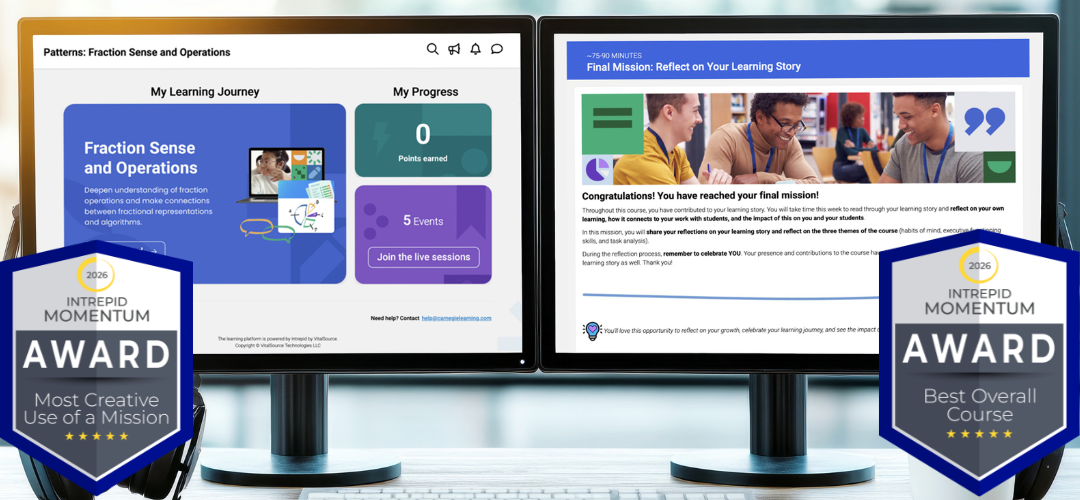
Built on the Intrepid platform, Patterns was initially launched as a structured, 10-week experience and blends asynchronous learning, live sessions, coaching, and real-world application.
Patterns® is designed as a continuous learning journey that extends professional learning beyond a single event. Teachers engage in three structured learning cycles, each introducing new concepts that are immediately applied in the classroom and then reflected on with peers, facilitators, and coaches.
By combining learning, implementation, coaching, and reflection throughout the school year, the program helps educators connect professional learning directly to classroom practice. These ongoing cycles reinforce new ideas through repeated application and provide opportunities for educators to refine their instructional approach over time.
“They have some learning, they try it, and then reflect with peers… and there are several cycles of that.”
Unlike traditional summer workshops, Patterns® runs during the school year, enabling teachers to apply what they’re learning in real time.
Patterns integrates coaching and peer reflection into the learning experience, leveraging the flexibility of online learning to provide a connection between ongoing professional learning and classroom experience. Participants engage with tasks, collaborate with facilitator-coaches to plan implementation, try new strategies with students, and then reflect with peer partners on what they learned from the experience.
This ongoing cycle helps educators translate new ideas into meaningful instructional change.
A core goal of Patterns® is to recreate the collaborative energy of in-person learning in a virtual environment. To achieve this, Carnegie Learning designed the experience around intentional interaction, using structured discussion prompts, facilitator-guided connections, and peer reflection partnerships.
Participants are not just completing coursework—they are actively engaging with one another, sharing strategies, and learning collaboratively in an asynchronous setting.
Built on the Intrepid platform, Patterns was initially launched as a structured, 10-week experience and blends asynchronous learning, live sessions, coaching, and real-world application.
1. Moving from Events to Ongoing Learning Cycles
Patterns® is designed as a continuous learning journey that extends professional learning beyond a single event. Teachers engage in three structured learning cycles, each introducing new concepts that are immediately applied in the classroom and then reflected on with peers, facilitators, and coaches.
By combining learning, implementation, coaching, and reflection throughout the school year, the program helps educators connect professional learning directly to classroom practice. These ongoing cycles reinforce new ideas through repeated application and provide opportunities for educators to refine their instructional approach over time.
“They have some learning, they try it, and then reflect with peers… and there are several cycles of that.”
2. Embedding Learning in the Flow of Work
Unlike traditional summer workshops, Patterns® runs during the school year, enabling teachers to apply what they’re learning in real time.
Patterns integrates coaching and peer reflection into the learning experience, leveraging the flexibility of online learning to provide a connection between ongoing professional learning and classroom experience. Participants engage with tasks, collaborate with facilitator-coaches to plan implementation, try new strategies with students, and then reflect with peer partners on what they learned from the experience.
This ongoing cycle helps educators translate new ideas into meaningful instructional change.
3. Designing for Deep Interaction at Scale
A core goal of Patterns® is to recreate the collaborative energy of in-person learning in a virtual environment. To achieve this, Carnegie Learning designed the experience around intentional interaction, using structured discussion prompts, facilitator-guided connections, and peer reflection partnerships.
Participants are not just completing coursework—they are actively engaging with one another, sharing strategies, and learning collaboratively in an asynchronous setting.
"... the balance of collaboration and independent learning offered very specific and tangible ideas I can use immediately with students this year."
Patterns Program Participant
“We’re really trying to get as much interaction as we can in this asynchronous environment.”
Intrepid’s collaborative features played a key role in supporting this approach. Carnegie Learning uses missions, discussion boards, learning paths, and SCORM integrations to create asynchronous experiences where participants can share mathematical thinking, respond to peers, and progress through guided learning sequences that reinforce reflection and application.
As part of the program’s evolution, Carnegie Learning has begun integrating AI-powered activities carefully and intentionally.
AI is used to:
But importantly, AI helps complement and personalize activities. But it doesn't negate human interaction. The team is deliberate about preserving human interaction and ensuring AI enhances, rather than replaces, the learning experience.
Intrepid’s collaborative features played a key role in supporting this approach. Carnegie Learning uses missions, discussion boards, learning paths, and SCORM integrations to create asynchronous experiences where participants can share mathematical thinking, respond to peers, and progress through guided learning sequences that reinforce reflection and application.
4. Thoughtful Innovation with AI
As part of the program’s evolution, Carnegie Learning has begun integrating AI-powered activities carefully and intentionally.
AI is used to:
- Simulate coaching conversations
- Support task analysis and reflection
But importantly, AI helps complement and personalize activities. But it doesn't negate human interaction. The team is deliberate about preserving human interaction and ensuring AI enhances, rather than replaces, the learning experience.
"The layout of the course was easy to follow, and I enjoyed the flexibility of the independent work, as a working mom."
Patterns Program Participant
5. Expanding Access to High-Quality Professional Learning
Since launching in spring 2024, Carnegie Learning has delivered both open and customized cohorts ranging from small groups of 5–10 educators to district-supported cohorts serving more than 100 participants.
By moving online, Patterns® expands access to high-quality professional learning for educators across states and districts, including those who may not otherwise have opportunities to participate in extended professional learning experiences.
For example, participants in Carnegie Learning's ongoing research partnership with WestEd and the North Carolina Department of Public Instruction include educators from rural districts across North Carolina, demonstrating how virtual delivery can help bring research-based professional learning to teachers regardless of geographic location.
This scalability allows Carnegie Learning to reach more educators while maintaining the depth and quality of its original in-person model.
Results: Early Impact and Emerging Outcomes
While Carnegie Learning is still in the early stages of long-term measurement, initial indicators point to meaningful impact.
Participants report:
Notably, even experienced educators are seeing value.
Across participant reflections, teachers consistently report a shift from a primarily procedural approach to a more student-centered, conceptually grounded approach to mathematics instruction. Educators, some with more than 10 years of experience, report becoming more intentional about encouraging multiple strategies, productive struggle, mathematical discussion, and deeper reasoning rather than focusing solely on rules or algorithms.
Feedback from participants highlights:
“I’ve taken other online courses, and this platform is the best one.”
Unlike traditional professional development, Patterns® emphasizes immediate implementation. Teachers are:
This signals early behavior change, not just knowledge acquisition.
One participant reflected on a classroom moment where students independently used fraction strips and visual models to reason through addition problems instead of relying on memorized procedures. For the teacher, the experience represented a shift in what success looked like, not simply getting the right answer quickly, but students confidently explaining their thinking and making sense of mathematics on their own.
To rigorously evaluate outcomes, Carnegie Learning has partnered with:
This ongoing study will measure:
As the Patterns® program continues to scale, Carnegie Learning is expanding the ways educators and districts can engage with the experience. In addition to its original virtual model, Carnegie Learning now offers flexible district cohorts that can be customized to fit local schedules and timelines, as well as hybrid implementations that combine extended in-person learning with ongoing online collaboration and reflection.
These options allow districts to choose the model that best meets their needs—from immersive in-person Academies, to hybrid experiences, to fully virtual learning pathways—while maintaining the research-based principles of interaction, reflection, and classroom application that define Carnegie Learning's professional learning approach.
At the same time, upcoming research findings will play a critical role in demonstrating measurable impact. Insights from the ongoing study will help validate the program’s effectiveness and inform future iterations, with a continued focus on improving both teaching practice and student outcomes.
Ultimately, Carnegie Learning’s goal is to move beyond one-time professional development for educators and establish a scalable model for continuous, classroom-embedded learning designed to create lasting impact for educators and the students they serve.
Shifts in Teacher Mindset and Practice
Participants report:
- Changes in how they think about math instruction
- Increased confidence in applying new strategies
- Adoption of new classroom practices
Notably, even experienced educators are seeing value.
Across participant reflections, teachers consistently report a shift from a primarily procedural approach to a more student-centered, conceptually grounded approach to mathematics instruction. Educators, some with more than 10 years of experience, report becoming more intentional about encouraging multiple strategies, productive struggle, mathematical discussion, and deeper reasoning rather than focusing solely on rules or algorithms.
High Engagement and Learner Satisfaction
Feedback from participants highlights:
- Strong engagement with course activities
- Appreciation for structured peer interaction
- Positive comparisons to other online learning experiences
“I’ve taken other online courses, and this platform is the best one.”
Evidence of Real-World Application
Unlike traditional professional development, Patterns® emphasizes immediate implementation. Teachers are:
- Actively applying concepts in their classrooms
- Reflecting on outcomes with peers
- Iterating across multiple learning cycles
This signals early behavior change, not just knowledge acquisition.
One participant reflected on a classroom moment where students independently used fraction strips and visual models to reason through addition problems instead of relying on memorized procedures. For the teacher, the experience represented a shift in what success looked like, not simply getting the right answer quickly, but students confidently explaining their thinking and making sense of mathematics on their own.
Building Toward Measurable Student Impact
To rigorously evaluate outcomes, Carnegie Learning has partnered with:
- WestEd (research organization)
- North Carolina Department of Public Instruction
This ongoing study will measure:
- Changes in teacher practice and beliefs
- Impact on student performance over time
What’s Next
As the Patterns® program continues to scale, Carnegie Learning is expanding the ways educators and districts can engage with the experience. In addition to its original virtual model, Carnegie Learning now offers flexible district cohorts that can be customized to fit local schedules and timelines, as well as hybrid implementations that combine extended in-person learning with ongoing online collaboration and reflection.
These options allow districts to choose the model that best meets their needs—from immersive in-person Academies, to hybrid experiences, to fully virtual learning pathways—while maintaining the research-based principles of interaction, reflection, and classroom application that define Carnegie Learning's professional learning approach.
At the same time, upcoming research findings will play a critical role in demonstrating measurable impact. Insights from the ongoing study will help validate the program’s effectiveness and inform future iterations, with a continued focus on improving both teaching practice and student outcomes.
Ultimately, Carnegie Learning’s goal is to move beyond one-time professional development for educators and establish a scalable model for continuous, classroom-embedded learning designed to create lasting impact for educators and the students they serve.