
North American freight-rail company Genesee & Wyoming Inc. and its subsidiaries (“G&W”) partnered with Intrepid to strengthen frontline leadership and improve employee retention. Through a cohort-based leadership program featuring AI-powered practice simulations, managers developed the skills to better engage and retain employees. The program contributed to measurable reductions in voluntary turnover.
Challenge
Like many organizations, G&W faced ongoing challenges with employee retention, particularly among frontline operations roles such as conductors and engineers.
While turnover is common in the rail industry due to the demanding nature of the work, internal exit data revealed that the primary drivers were not compensation- or workload-related.
Instead, two consistent themes emerged:
Generational differences in expectations around communication, feedback, and emotional intelligence also created gaps between experienced railroad leaders and newer employees.
In 2023, voluntary turnover stood at 13%, prompting the organization to rethink how frontline supervisors were prepared to lead, engage, and retain employees.
While turnover is common in the rail industry due to the demanding nature of the work, internal exit data revealed that the primary drivers were not compensation- or workload-related.
Instead, two consistent themes emerged:
- Employees leaving due to manager relationships
- Employees perceiving limited growth or development opportunities
Generational differences in expectations around communication, feedback, and emotional intelligence also created gaps between experienced railroad leaders and newer employees.
In 2023, voluntary turnover stood at 13%, prompting the organization to rethink how frontline supervisors were prepared to lead, engage, and retain employees.
0%+
Reduction in
Voluntary Employee Turnover
Voluntary Employee Turnover
0
Leadership Development Experiences Delivered Across the U.S.
Solution
G&W partnered with Intrepid to design and deliver a Retention Through Engagement leadership program, combining leadership education, self-awareness, and practical skill development through cohort-based learning with AI-powered practice. The initiative initially launched as a targeted pilot with nine G&W railroads experiencing higher than average turnover, allowing the organization to focus early efforts where impact was most needed.
The program evolved in phases:
Phase 1: Awareness and Retention Education
Leaders explored what retention truly means and examined common assumptions around employee motivation and generational expectations.
Phase 2: Leadership Self-Awareness
Using Myers-Briggs Type Indicator (MBTI) assessments, leaders gained insight into how their communication and leadership styles influenced engagement and retention.
Team profiles helped leaders identify blind spots and adapt their approaches to better support employees with different working styles.
Phase 3: Cohort-Based Learning on Intrepid
The final phase brought the learning together in a five-week digital cohort program where frontline leaders practiced real-world leadership scenarios and exchanged ideas with peers across the organization.
Participants spent 1.5–2 hours per week engaging in discussions, activities, and live sessions focused on improving retention and engagement practices.
The program evolved in phases:
Phase 1: Awareness and Retention Education
Leaders explored what retention truly means and examined common assumptions around employee motivation and generational expectations.
Phase 2: Leadership Self-Awareness
Using Myers-Briggs Type Indicator (MBTI) assessments, leaders gained insight into how their communication and leadership styles influenced engagement and retention.
Team profiles helped leaders identify blind spots and adapt their approaches to better support employees with different working styles.
Phase 3: Cohort-Based Learning on Intrepid
The final phase brought the learning together in a five-week digital cohort program where frontline leaders practiced real-world leadership scenarios and exchanged ideas with peers across the organization.
Participants spent 1.5–2 hours per week engaging in discussions, activities, and live sessions focused on improving retention and engagement practices.
"The structure is built once—content, discussion prompts, activities—so whether someone is in the Pacific Northwest, the South, or corporate, they’re working through the same material and expectations.”
Genesee & Wyoming Inc.
Scalable Learning Across North America
The cohort model enabled G&W to train leaders across the U.S. simultaneously.
Across all phases of the initiative, about 150 leadership development experiences were delivered across the U.S. The digital format allowed leaders from very different operational environments to learn together.
According to G&W:
“The structure is built once—content, discussion prompts, activities—so whether someone is in the Pacific Northwest, the South, or corporate, they’re working through the same material and expectations.”
This approach also created valuable cross-regional connection and learning:
The result was a scalable leadership development model that maintained consistency while supporting real operational conversations.
AI-Powered Personalized Learning Activities
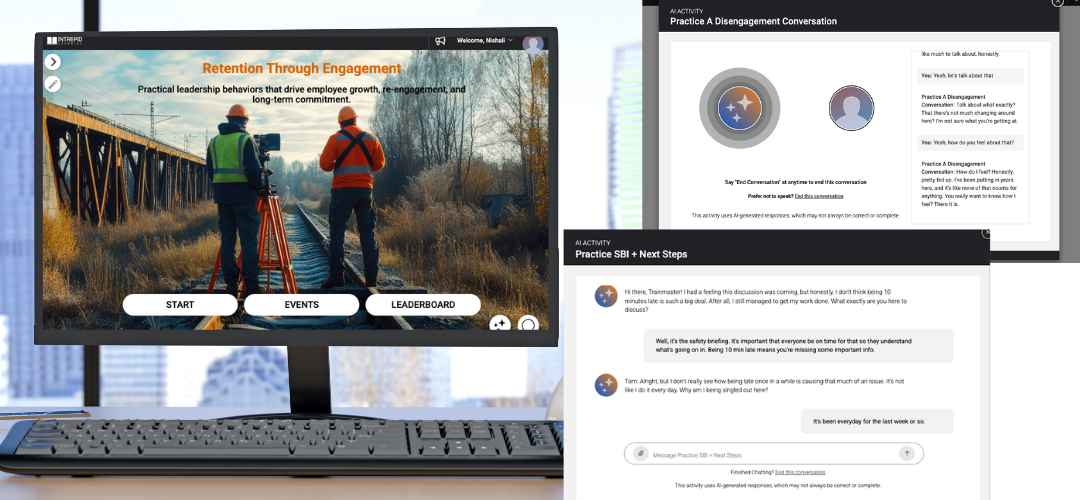
One of the most impactful elements of the program came when G&W replaced traditional video-based practice with Intrepid’s AI-powered personalized learning activities (AI Activity).
Initially, leaders were asked to record themselves responding to scenarios on video. Participation was low, and most leaders treated the activity as a single required submission.
When the program switched to AI-powered conversational simulations, engagement changed immediately.
According to G&W:
“With the video, most participants disliked it. It was more of a one-and-done experience. With AI Activity, leaders practiced multiple times and experimented with different approaches.”
Instead of watching a scenario unfold, leaders were now actively participating in a simulated conversation, responding in real time and adjusting their approach based on the AI’s responses.
This dramatically increased practice and reflection.
Participant feedback included:
One operations leader noted that the simulation allowed him to “mess up in private” before having the real conversation with an employee, something particularly valuable in environments where credibility and authority are important.
The AI Activity effectively closed the gap between learning and application by letting leaders practice difficult conversations repeatedly before having them in the field.
The cohort model enabled G&W to train leaders across the U.S. simultaneously.
Across all phases of the initiative, about 150 leadership development experiences were delivered across the U.S. The digital format allowed leaders from very different operational environments to learn together.
According to G&W:
“The structure is built once—content, discussion prompts, activities—so whether someone is in the Pacific Northwest, the South, or corporate, they’re working through the same material and expectations.”
This approach also created valuable cross-regional connection and learning:
- Leaders shared how they handle engagement and performance challenges
- Silos between railroads and regions began to break down
- The program could be refined between cohorts without rebuilding the entire experience
The result was a scalable leadership development model that maintained consistency while supporting real operational conversations.
AI-Powered Personalized Learning Activities
One of the most impactful elements of the program came when G&W replaced traditional video-based practice with Intrepid’s AI-powered personalized learning activities (AI Activity).
Initially, leaders were asked to record themselves responding to scenarios on video. Participation was low, and most leaders treated the activity as a single required submission.
When the program switched to AI-powered conversational simulations, engagement changed immediately.
According to G&W:
“With the video, most participants disliked it. It was more of a one-and-done experience. With AI Activity, leaders practiced multiple times and experimented with different approaches.”
Instead of watching a scenario unfold, leaders were now actively participating in a simulated conversation, responding in real time and adjusting their approach based on the AI’s responses.
This dramatically increased practice and reflection.
Participant feedback included:
- “This feels more like a real conversation.”
- “I didn’t realize how quickly my tone shifted until I saw the response.”
- “I tried it again to see if I could handle it better.”
One operations leader noted that the simulation allowed him to “mess up in private” before having the real conversation with an employee, something particularly valuable in environments where credibility and authority are important.
The AI Activity effectively closed the gap between learning and application by letting leaders practice difficult conversations repeatedly before having them in the field.
"With the video, most participants disliked it. It was more of a one-and-done experience. With AI Activity, leaders practiced multiple times and experimented with different approaches.”
Genesee & Wyoming Inc.
Impact on Leadership Confidence
While a formal long-term behavior study has not yet been conducted, qualitative feedback shows clear improvements in how leaders approach retention conversations.
Across discussions, surveys, and follow-up conversations, leaders consistently reported feeling more prepared to address disengagement and career development.
Common feedback themes included:
- Leaders felt more confident initiating conversations they had previously avoided
- Leaders became more intentional about asking questions instead of immediately solving problems
- Leaders began identifying early warning signs of disengagement
As one participant explained:
“I realized I was jumping straight to problem-solving instead of asking questions.”
G&W also reported strong participation in the AI simulations, significantly higher than engagement seen in previous video-based exercises.
Results
The Retention Through Engagement initiative produced measurable improvements in workforce stability and leadership capability:
Participants consistently reported feeling more confident initiating conversations they had previously been reluctant to start, particularly around retention risk, motivation, and development. Many leaders noted they became more intentional about asking questions and identifying early signs of disengagement before problems escalated.
The program has also become a foundation for continued leadership development at G&W. The organization has already reused the cohort model and expanded AI-powered simulations into additional training programs, including leadership practice using the GROW coaching model and SBI feedback framework.
Why It Matters
In an industry where high turnover is often considered unavoidable, G&W demonstrated that equipping frontline leaders with the right tools can significantly improve retention.
Compared with larger Class 1 railroads, G&W’s structure allows employees greater visibility into the business, more accessible leadership, and more sustainable work-life balance. Many rail professionals choose to continue their careers at G&W for these reasons.
By combining cohort learning, peer collaboration, and AI-powered practice, G&W created a scalable leadership development model that helps managers address disengagement early—before employees decide to leave.
- 10%+ Reduction in Voluntary Turnover: Turnover dropped by over 10%, even with a few leadership changes.
- Leadership Development Delivered at Scale: about 150 leadership development experiences were delivered.
- Cross-Regional Learning Across the U.S.: Leaders from G&W railroads across the U.S. participated in the same cohorts, sharing strategies and challenges from very different operational environments.
- Higher Engagement with AI-Powered Practice: After a successful implementation pilot group and test period, and replacing video-based assignments with AI Activity simulations, leaders practiced difficult conversations multiple times, experimenting with different approaches to disengagement and career development discussions.
Participants consistently reported feeling more confident initiating conversations they had previously been reluctant to start, particularly around retention risk, motivation, and development. Many leaders noted they became more intentional about asking questions and identifying early signs of disengagement before problems escalated.
The program has also become a foundation for continued leadership development at G&W. The organization has already reused the cohort model and expanded AI-powered simulations into additional training programs, including leadership practice using the GROW coaching model and SBI feedback framework.
Why It Matters
In an industry where high turnover is often considered unavoidable, G&W demonstrated that equipping frontline leaders with the right tools can significantly improve retention.
Compared with larger Class 1 railroads, G&W’s structure allows employees greater visibility into the business, more accessible leadership, and more sustainable work-life balance. Many rail professionals choose to continue their careers at G&W for these reasons.
By combining cohort learning, peer collaboration, and AI-powered practice, G&W created a scalable leadership development model that helps managers address disengagement early—before employees decide to leave.