
UnitedHealthcare (UHC) launched an app to help members get critical information and answers to some of their top questions: how to check their benefits, find a provider, or review the status of their claims. The goal was to improve the member experience and help members stay engaged in their health and well-being -- which can lead to better health outcomes and lower costs.
But building an app doesn’t mean members will use it. Members often didn’t know the app existed, and UHC needed to find ways to let them know about it and encourage them to use it. Call center advocates are the frontline team members who interact with members and could make that happen.
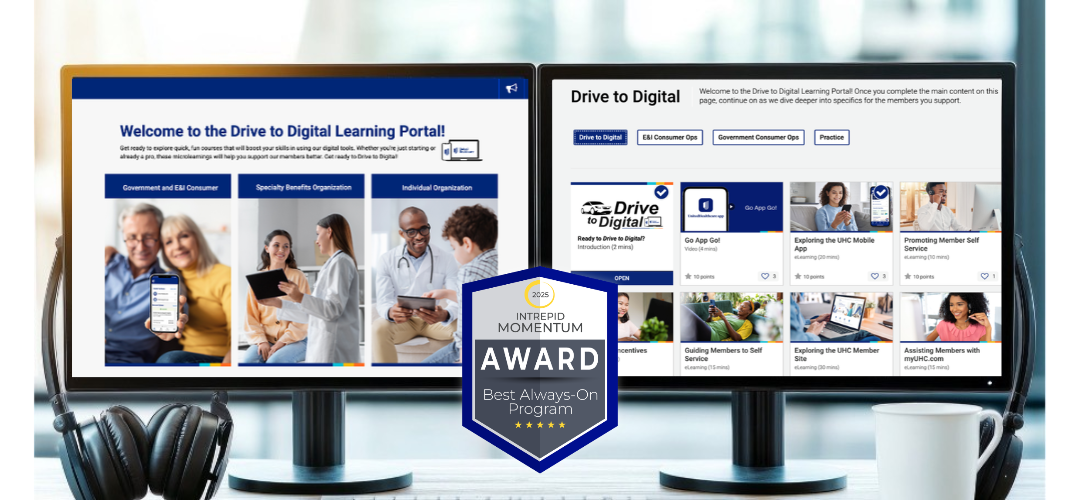
Drive to Digital is the upskilling solution UHC built to prepare advocates to enable member digital adoption.
0.6M
Calls
Obviated
Obviated
0%
Increase in
Member Chats
Member Chats
The Challenge
UHC needed to equip approximately 20,000 call center advocates — distributed across the U.S. and globally, serving five lines of business — with the skills and confidence to guide members toward digital self-service. The business goal was a measurable shift in member behavior: more app visits, more digital channel adoption, and fewer calls for tasks members could handle themselves.
The program had to work around a variety of constraints:
The program had to work around a variety of constraints:
- Range of experience. Long-tenured U.S.-based staff with deep healthcare knowledge worked alongside globally distributed team members brought in during peak periods like open enrollment.
- Varying comfort with technology. Advocates came in with different levels of comfort with the digital tools they were being asked to support. They needed to be equipped to answer member questions about those tools without escalating to technical support.
- Consistency at global scale. One unified learning experience had to work for every advocate, in every region and line of business.
- Always-on access. This couldn't be a cohort program with a start date. Advocates join teams continuously, so the program had to be available when they joined and flexible enough to fit around their workday.
"Corporate learning isn't academic. It exists to drive performance. So, we're building a function the business can count on when the environment changes, which it always does."
Christy Pletcher,
Vice President, Learning & Development
The Solution
Built with Intrepid's applied learning platform, Drive to Digital gives a distributed workforce the access, practice, and peer support to guide members to digital.
- Flexible access and a scalable learning journey. The program's always-on structure allowed advocates to access it during scheduled breaks, between calls, and across time zones — with no fixed start date or single delivery format locking them out. The same learning journey scales across regions, roles, and lines of business, so flexibility doesn't come at the cost of a consistent experience.
- Real-world application from the start. Advocates practiced member call scenarios in AI simulations and got feedback before taking calls with real members. Because many advocates aren't UHC members themselves, the program also simulated the member experience — including the digital tools they were guiding members through. They worked on building trust, showing empathy, and guiding members through digital tasks, so practice happened before the stakes were real.
- Peer learning built into the design. By sharing their experiences supporting members with digital adoption, both new and tenured advocates contributed to an ever-growing body of peer support they could draw upon when needed. Advocates weren't just learning from content. They were learning from each other.
0%
YoY Increase in
Mobiel App Visits
Mobiel App Visits
0
Learner
NPS
NPS
What the Results Say
Success meant members getting answers on their own, and advocates ready to guide them. The numbers show both:
"L&D doesn't just support the program. We have to be a performance engine for the business — a different kind of function."
- 56% increase in member chats — advocates successfully shifting interactions to digital channels
- 76% year-over-year increase in mobile app visits — members adopting self-service at a meaningful rate
- 3% of calls obviated — 2.6 million calls that didn't happen because members were better equipped to help themselves
- 96 Learner NPS — a signal that advocates felt genuinely prepared
"L&D doesn't just support the program. We have to be a performance engine for the business — a different kind of function."
Five Lessons From Building Drive to Digital at Scale
- Design for constant change, not one-time launches. The business environment that Drive to Digital was built for kept shifting. A program designed for a single launch would have been out of date before it finished rolling out. The design framework had to support continuous iteration, not periodic refreshes.
- Advocate for the human side of digital adoption. Guiding a member to use an app instead of calling requires more than technical knowledge. It requires empathy, trust-building, and the ability to understand what's making digital feel hard for that specific member.
- Help people change how they work, not just what they know. The advocates in this program were asked to change how they do their jobs. Teaching new skills was only half of it. The other half was shifting habits, building confidence, and working through the resistance that comes with any new way of doing things.
- Use AI to scale practice and coaches to build judgment. The program didn't choose between AI-enabled scale and human connection — it built both in deliberately. AI practice simulations give advocates reps without risk. Human coaching and peer collaboration build the real-world experience needed to help advocates develop judgment and confidence.
- Measure behavior change and business impact. Too often L&D feels the need to prove it solely caused a particular business outcome. But business environments are rarely that simple — L&D operates in a broader context. The real task is defining and aligning learning metrics directly to business outcomes that stakeholders care about. And spoiler: those aren't course completions.
Where UHC Goes From Here
Drive to Digital is one program inside a larger shift in how UHC's L&D function operates. That broader redesign, led by Christy's team, is still underway. Roles are being reoriented to emphasize a fundamental change in the role of L&D — from training delivery to performance consulting, from reactive order-taking to strategic influence, and from a focus on traditional training measures to data-driven business results.
"Corporate learning isn't academic. It exists to drive performance. So we're building a function the business can count on when the environment changes — which it always does."
— Christy Pletcher, Vice President of Learning and Development, UnitedHealthcare
"Corporate learning isn't academic. It exists to drive performance. So we're building a function the business can count on when the environment changes — which it always does."
— Christy Pletcher, Vice President of Learning and Development, UnitedHealthcare