
Health plans operate in an environment where member needs, technology, regulations, and workforce roles are constantly changing. The people serving those members have to keep pace.
Key Takeaways
- Workforce readiness now depends on speed to capability. As skill needs change faster, annual planning and long training-development cycles can leave organizations preparing people for yesterday’s needs.
- AI can accelerate capability building, but adoption alone isn’t enough. GuideWell uses AI to help its learning team move faster while also developing the critical thinking and human judgment employees need to work effectively with AI.
- Knowing a skill isn’t the same as being able to apply it. GuideWell is moving toward AI simulation to add skill application to its existing knowledge assessments and create more personalized, role-specific development.
- Continuous upskilling is becoming an operating requirement. GuideWell revisited enterprise competencies within six months and deployed 26 courses in just two months (six of them being new).
Most learning functions are still designed for a pace of change that no longer exists. Programs take months to build, months to deploy, and by the time they reach learners, the skills landscape has already shifted. The result is a growing gap between the capabilities the business needs and how quickly L&D can build them.
It’s a problem we hear consistently from the learning leaders we work with. On an episode of Being Intrepid, we talked with Kristine Ellis, Senior Director of Talent Development and Management at GuideWell, the parent organization of Florida Blue. Her team has won the ATD Best Award 12 times (one of only six organizations globally with that distinction) and she’s actively rebuilding how her function operates.
For GuideWell, the challenge comes down to speed to capability: workforce readiness increasingly depends on how quickly people can build and apply the skills the business needs, not how quickly another course can be produced.
When Annual Planning Cycles Outlive the Skills They’re Built Around
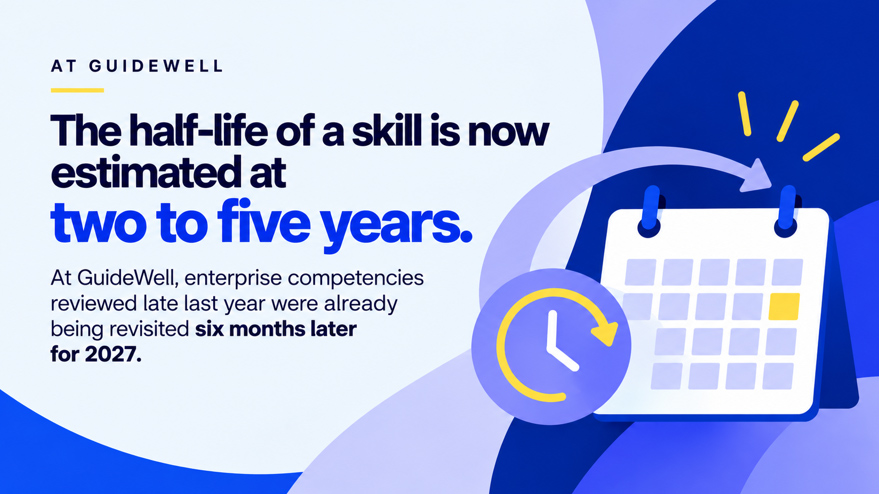
The half-life of a skill is now estimated at two to five years, and that compression is forcing a fundamental rethink of how learning functions plan, build, and measure their work.
What that looks like in practice: GuideWell reviewed organizational competencies in December and January, and six months later was already revisiting them to plan for 2027. Not because the first review was wrong, but because the landscape moved.
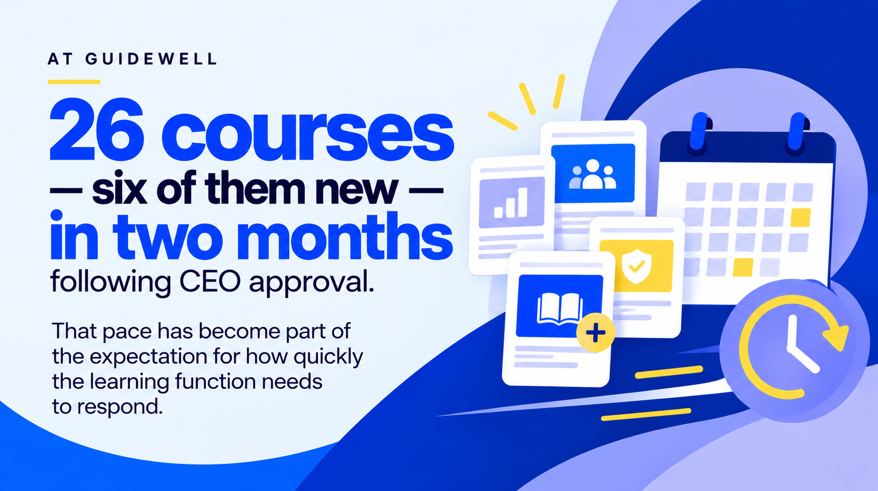
When their CEO approved a major initiative, Kristine’s team deployed 26 courses, six of them new, in two months. As she put it: “We’ve set the bar high, so now we have to keep up with the speed that is expected of us.”
Speed at that level requires the right infrastructure: AI-assisted content development, real-time skills data, and a team with enough depth and flexibility to mobilize fast.
The Real Gap Isn’t Content. It’s Knowing What You’re Building Toward
Speed matters, but speed without direction produces a lot of content that doesn’t close the right gaps. The challenge is that many L&D functions don’t have a reliable, real-time picture of what their workforce knows or where skill levels are falling short.
Kristine made an observation that stuck with us: LinkedIn often has a more accurate view of an organization’s workforce skills than the organization itself does. If your people are documenting their capabilities on a social platform faster than your systems can capture them, you’re making program decisions based on outdated or incomplete signals.
At GuideWell, the team built skills assessments directly into their LMS and mapped them to annual competencies. At any point, Kristine can pull a dashboard view of skill levels across the company by business unit or by competency area and see where gaps are growing before they become critical.
She’s also clear-eyed about what the data can and can’t tell her:
“It doesn’t assess application.”
Knowing whether an employee understands a skill is not the same as knowing whether they can use it effectively in the situations their role requires. What GuideWell’s approach gets right is using assessment data as a signal to focus and then investing in structured learning experiences that drive application, not just awareness.
Skills data identifies the gap. Applied practice builds the capability. Evidence of application shows whether people can perform.
AI Isn’t the Workforce Strategy. It’s an Enabler of Speed.
There’s a version of AI adoption in L&D that looks like selecting tools and training people to use them. That’s not the same as building genuine AI capability in a team.
Nearly three years ago, GuideWell built an internal large language model called GuideWell Chat. That head start gave the team time to genuinely integrate AI into their workflows rather than scrambling to adopt it reactively. By the time AI was on everyone’s agenda, Kristine’s team was already running pilots and developing expertise through curiosity and hands-on use, not top-down mandates.
The result: team members became advocates because they’d seen what the tools could do. “Once they saw how quickly we can do that,” Kristine said, “their passion became: let’s help others see how quickly they can work with this amazing tool.”
There’s a harder leadership question embedded in that story, too. One team member, responsible for graphics and animation, was resistant when GuideWell Chat launched. His concerns were valid. What changed wasn’t pressure to adopt; it was coaching toward a clearer picture of where his judgment and expertise would matter more as AI tools grew more capable, not less.
Two years later, his role has expanded into content quality oversight, accessibility standards, and discernment work. His skills grew and his contribution got broader.
That’s workforce upskilling in practice: not simply teaching someone to use AI, but helping an existing employee adapt their skills and contribution as the work itself changes.
GuideWell now runs two parallel AI courses: a prompting lab and a critical thinking class. The critical thinking class is the more instructive of the two. It doesn’t open an LLM at all. It focuses on how to think before, during, and after AI use, asking the right questions, evaluating outputs, knowing when to push back.
The team has a term for what happens without that discipline: workslop. Running a prompting lab without the critical thinking class is a strategy for producing workslop at scale. AI isn’t a tool you hand to a team, it’s a capability the team needs to build. Technical fluency matters, but so does the judgment to know when, where, and how to use it.
The Next Step: From Knowing a Skill to Demonstrating It
GuideWell’s current skills infrastructure creates visibility into what employees know. Kristine is already thinking about the next question: can they apply it?
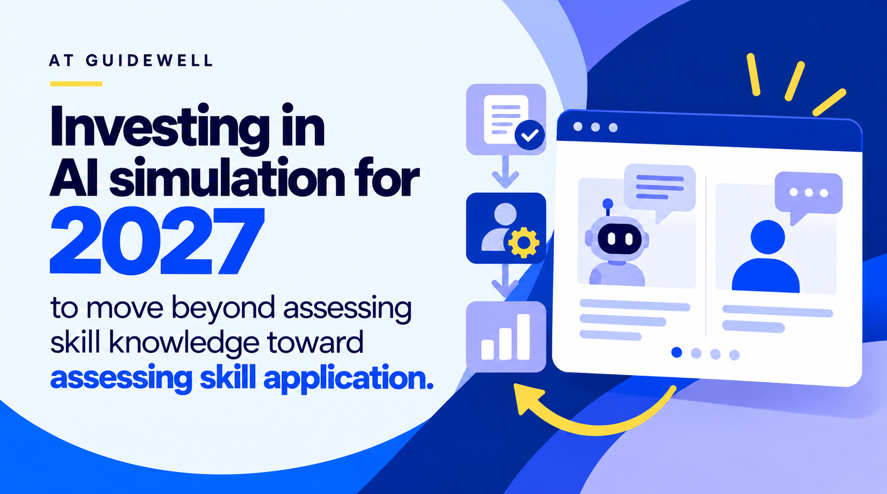
That’s why AI simulation is one of the investments she’s most excited about for 2027. The potential is to create role-specific environments where employees don’t simply answer questions about a capability, they practice using it in context.
GuideWell’s CEO is already pushing further: what Kristine describes as an “N of one” experience, or development at an individual’s own pace, level, and role. Instead of everyone receiving the same training because they share a job title, assessment can identify where an individual needs development and practice can focus on building and demonstrating those specific capabilities.
What GuideWell’s Experience Tells Us About Workforce Readiness
GuideWell’s experience points to five principles for learning functions trying to keep pace with changing business needs:
- Get a real-time skills baseline. Competency reviews that happen once a year are already behind. The signal you need to move fast is a live view of where skill levels are: by role, by team, by capability area.
- Measure knowledge and application separately. What people know and what people do are different data points. Assessment scores tell you one thing. Applied practice and evidence of performance tell you another.
- Build AI capability, not just AI adoption. Pair access to AI with the skills and judgment required to use it effectively.
- Design for continuous upskilling. Roles will change. Processes will change. Technology will change. Workforce development can’t be treated as an occasional intervention.
- Invest in personalization infrastructure now. GuideWell’s CEO is pushing for an N of one experience for employees, or individualized development at scale. Assessment and simulation can help target development to the skills each employee needs to build and apply.
Workforce Readiness Has Become a Moving Target
Workforce readiness isn’t something an organization achieves once. The target keeps moving, which requires identifying changing skill needs earlier, building capability faster, and creating better evidence that people can apply what they’ve learned.
Human judgment remains a critical differentiator for the future of the function. The goal is to use AI to increase the speed and personalization of capability development while keeping human judgment where it matters most.
That’s what speed to capability ultimately means: not producing training faster, but keeping the workforce equipped to perform as the work itself changes.
Explore how Intrepid helps organizations turn learning into applied capability.
Frequently Asked Questions About Workforce Readiness at Health Plans
What metrics should health plans use to measure agent readiness beyond training completion?
Completion rates and quiz scores measure whether an agent went through training, but can’t tell you if they can perform. More useful metrics include practice performance in scenario-based simulations, QA scores in the first 60 days, 90-day retention, and time to proficiency. The shift is from measuring activity to measuring demonstrated capability. An agent who passes a knowledge check may still struggle to explain a benefit change to a confused member. That gap only becomes visible through applied practice.
How does member services agent readiness affect health plan member experience?
Agents who aren’t ready hurt member experience before supervisors have time to correct it. Longer handle times, more escalations, and compliance exposure all trace back to agents who completed training but weren’t prepared to perform. UnitedHealthcare saw NPS improve from 35 to 72 after shifting to an applied learning approach focused on call-ready capability. A member’s experience of a health plan is largely shaped by the agent they reach and how quickly and clearly that agent can help them.
What does it mean for a health plan workforce to be ready, not just trained?
A trained workforce has completed the required coursework. A ready workforce can apply it in the situations the job requires. For health plan member services, that means an agent can explain a benefit change clearly, navigate a formulary question under time pressure, and stay within compliance boundaries, not just answer a quiz about them. Readiness is demonstrated through applied practice and evidence of performance, not completion percentages.
How can health plans build learning programs that keep pace with regulatory and role changes?
The core requirement is moving from annual program cycles to continuous capability development. GuideWell reviewed enterprise competencies in late 2025 and was already revisiting them six months later for 2027. When their CEO approved a new program, the team deployed 26 courses, six of which were new, in two months using AI-assisted development. Health plans that build a real-time skills baseline by role and team, and shorten design and deployment cycles, are better positioned to respond when CMS guidance changes or technology shifts the work.
What is the difference between assessing skill knowledge and assessing skill application?
Knowledge assessment measures whether an employee understands a skill, typically through quizzes or LMS-based tests. Application assessment measures whether they can perform it in real conditions. Kristine Ellis, Senior Director of Talent Development at GuideWell, uses LMS-based skills assessments mapped to organizational competencies and is direct about the limitation: “It doesn’t assess application.” AI simulation closes that gap by creating role-specific environments where employees practice a skill in context rather than answer questions about it.
How can L&D leaders in healthcare payers make the business case for AI simulation?
Connect AI simulation to outcomes operations leaders already track: time to proficiency and 90-day retention. Simulation moves learning from knowledge assessment to application assessment, giving health plans evidence an agent can handle a real member conversation before they’re live. Compressing ramp time by 33 weeks recovers approximately $37,000 in productive capacity per new hire, based on fully loaded labor costs for a member services role. That’s the business case. The L&D case for scalable practice, personalized feedback matters to learning leaders. The proficiency and retention case reaches the COO.
What does workforce readiness in healthcare mean?
Workforce readiness in healthcare means employees can perform the skills their roles require right now, not just that they completed training. In health plan operations, where regulations change and member needs shift across enrollment periods, readiness is a moving target. GuideWell defines it around speed to capability: how quickly the workforce can build and apply the skills the business needs as those needs evolve. A workforce that was ready six months ago may need new capabilities today.
What is workforce development in health care?
Workforce development in healthcare is the ongoing investment in building employee skills across clinical, operational, and member-facing roles, including onboarding, upskilling, and reskilling as technology and regulations change. In health plan operations, it has historically meant compliance training and LMS-based content. The current challenge is making it fast and specific enough to keep pace with a healthcare environment that changes continuously. That requires real-time visibility into skill gaps, applied practice, and performance evidence.
Can you give me some examples of workforce readiness?
GuideWell built a real-time skills dashboard mapped to organizational competencies, giving leaders visibility into capability gaps before they become critical. When their CEO approved a major initiative, the team deployed 26 courses in two months and that pace became the operating standard. For UnitedHealthcare’s Medicare Appeals and Grievances program, workforce readiness meant compressing agent ramp time from nine months to six weeks through scenario-based practice and applied learning before agents went live. Both examples share the same principle: readiness is built through practice and verified through performance, not confirmed by a completion dashboard.