

Healthcare systems are in the middle of a slow-moving leadership crisis. As veteran leaders retire and workforce burnout grows, organizations are in desperate need of robust leadership pipelines to navigate digital transformation, value-based care models, and evolving patient expectations. Yet most approaches to leadership in healthcare remain outdated and simply cannot deliver leaders at the scale and speed today’s complex health systems demand.
It’s not as if organizations don’t recognize this is a problem. Brandon Hall Group™ research shows that 58% of organizations are prioritizing improved high-potential development and succession planning, and 53% focus on aligning leadership development strategy with business objectives. Despite this strategic focus, healthcare organizations continue to struggle with fragmented approaches that fail to connect leadership capabilities with measurable outcomes and struggle to scale cohort-based programs that deliver only a fraction of the leaders they need.
But forward-thinking healthcare organizations are taking a different path. By shifting from small, fragmented programs to enterprise-scale leadership development that blends digital innovation, AI-powered practice, and collaborative peer learning, health systems can finally build consistent pipelines of leaders who are ready to perform — and stay.
Key Takeaways
- Healthcare faces a leadership crisis as retirements, burnout, and rapid change outpace outdated programs that can’t scale.
- Common challenges include small programs limited to dozens of leaders, fragmented systems that raise costs, inconsistent training across facilities, and critical gaps in soft skills like empathy and decision-making.
- Forward-thinking organizations are succeeding by adopting scalable, practice-based leadership development that ties directly to workforce retention, equity, and measurable business impact.
Healthcare and Leadership Development: Common Challenges
Healthcare leadership development at most organizations is finding itself unequal to the moment. Despite widespread recognition of their importance, most leadership development programs suffer from systemic issues that prevent real impact:
Small Leadership Programs That Don’t Scale
Most healthcare leadership programs remain constrained to small groups of 20-30 high-potential individuals, while health systems need to develop hundreds or thousands of leaders across multiple sites, specialties, and organizational levels. Traditional instructor-led training approaches are limited in reaching the mid-level managers, department heads, charge nurses, and emerging leaders who form the operational backbone of healthcare delivery.
The result is a dangerous gap: too few prepared leaders to guide teams through regulatory change, digital transformation, and value-based care shifts.
Disconnected Program Management
Healthcare organizations typically cobble together 6-8 different systems to manage leadership development—from learning management systems (LMS) and virtual meeting tools to communication platforms and assessment systems. This fragmented approach creates enormous coordination overhead while delivering inconsistent learner experiences.
The administrative burden doesn’t just waste time—it raises program costs and prevents scaling leadership opportunities to the broader workforce. Brandon Hall Group™ research underscores this challenge: 57% of survey respondents rate time as a “significant” or “heavy” constraint on learning initiatives.
Lack of Consistency and Alignment Across the Organization
Geographic distribution across multiple facilities compounds coordination challenges, as health systems struggle to deliver consistent leadership training experiences while managing complex logistics and travel costs. This inconsistency directly impacts workforce alignment, creating uneven leadership quality that ultimately influences patient outcomes, engagement, and retention.
Skills That Can’t Keep Up with Rapid Change
Healthcare leadership requirements evolve faster than traditional annual training cycles can address them. Leaders need continuous adaptation to manage hybrid workforces, implement digital health technologies, navigate regulatory changes, and respond to shifting consumer expectations.
Critical Soft Skills Gaps in Healthcare Leadership Roles
Healthcare leaders increasingly need sophisticated capabilities in coaching, empathy, business acumen, and decision-making to manage distributed teams, drive engagement, and improve patient outcomes. Yet these foundational leadership competencies are often the most underdeveloped in clinical professionals who advance into leadership roles based on technical expertise rather than leadership readiness.
Limited Visibility Into Program Impact
Most healthcare organizations struggle to move beyond simple completion metrics and satisfaction surveys to demonstrate the real business impact of their leadership development investments. Without clear connections to retention rates, learner engagement scores, quality metrics, and patient satisfaction measures, L&D leaders cannot build compelling business cases for program expansion or improvement.
A Modern Solution: Enterprise-Scale Healthcare Leadership Training
At Intrepid, we’ve worked with progressive, outcome-driven healthcare organizations to address these challenges. Our approach is built for scale, equity, and measurable business impact — helping health systems move from small, fragmented leadership programs to enterprise-wide pipelines that improve retention, workforce sustainability, and care quality. By embracing modular, scalable leadership journeys delivered through digital cohorts, organizations can maintain the peer interaction and collaboration that make traditional programs effective—while achieving the scale, consistency, and flexibility that healthcare demands.
Here’s what this looks like in practice:
Blend Digital and In-Person Experiences Strategically
The most successful healthcare leadership programs we’ve supported create blended learning experiences that combine virtual cohort activities with targeted in-person touchpoints. Time-released content delivery allows participants to engage between patient care responsibilities, while cohort-based discussions ensure peer learning remains central to the experience. This approach eliminates the geographic and scheduling barriers that have traditionally limited executive healthcare leadership program participation while dramatically reducing travel and instructor costs.
Transform Skill Practice with AI-Powered Coaching
Our AI Activity technology enables healthcare leaders to practice high-stakes conversations in safe, simulated environments. Unlike one-off workshops, leaders can practice repeatedly, receiving adaptive feedback that evolves with their responses. This provides unlimited opportunities to refine skills such as conflict resolution, patient family discussions, or performance management — without overburdening scarce facilitator resources. This allows leaders to refine their approach and build confidence before applying new healthcare leadership skills in clinical settings where the stakes are highest.
Drive Immediate Value Through Real-World Application
In our experience, the most effective modern healthcare leadership development programs emphasize missions and projects tied directly to participants’ actual responsibilities. A department head might work on improving staff engagement metrics while learning change management principles, or a service line director could develop value-based care strategies while building financial acumen. This ensures leadership journeys are not abstract training, but engines of real performance improvement that can be measured and scaled.
Eliminate Fragmentation with Integrated Technology Platforms
Rather than managing multiple disconnected tools, Intrepid’s cohort learning platform consolidates content delivery, peer collaboration, and outcome measurement into one cohesive experience. This not only reduces administrative burden but also ensures every leader — from charge nurses to department heads — receives a consistent experience aligned to organizational strategy.
Enable Meaningful Impact Assessment with Data-Driven Insights
Our real-time analytics help organizations understand behavioral changes, skill development, and business impact. Organizations can identify skill gaps, track leadership pipeline readiness, and connect development investments to key outcomes (e.g. retention rates, engagement scores, and quality of care metrics).
Watch how Intrepid’s AI Activity helps leaders practice challenging conversations, so leaders can build confidence and refine their approach before the real moment arrives.
Proof Points: Healthcare Leadership Development Success in Action
In an Intrepid podcast interview, Darci Hall, Kaiser Permanente’s Head of HR Strategy, Learning & Development, shared practical strategies for scaling leadership development in healthcare.
Kaiser’s strategy treats learning as a key lever to improve performance, retention, and affordability—key priorities in healthcare sustainability. Through this approach, Kaiser achieved measurable ROI such as an estimated $53 million saved by a 1% improvement in retention rates.
The organization’s focus on creating talent mobility links leadership development to equity and workforce sustainability. In other words, by investing in career progression focused development, Kaiser is retaining talent while developing much needed leadership capabilities. Her insights reflect the kind of forward-thinking strategy health systems can adopt to address today’s leadership challenges.
Blanchard, an Intrepid partner, delivers leadership development programs on our platform for global organizations like Becton Dickinson (BD).
On the Being Intrepid podcast, Marilyn Allison, Senior Director of Learning & Leadership Development at BD, shared her approach to aligning leadership development directly to the CEO’s strategy. She emphasized the need to build enduring human skills—such as empathy, learning agility, and critical thinking—that are more “bulletproof” than technical expertise and essential in a fast-changing healthcare landscape. Marilyn also spoke about navigating the paradox between personalizing development for individual leaders while still creating a common language and shared direction across the enterprise.
These priorities come to life in BD’s Rise: Building Manager Foundations program, which Blanchard delivers on Intrepid. Rise is a 12-week blended journey that combines Blanchard’s leadership expertise with Intrepid’s scalable, practice-driven platform. Thousands of BD managers worldwide participate in a consistent, branded experience that reflects BD’s culture and values. Learners engage through peer discussions, digital simulations, and real-world projects, applying leadership concepts to their day-to-day responsibilities.
The results are compelling:
- 91% of managers reported gaining clarity on what it takes to succeed as a BD leader.
- 85% said they are more committed to staying at the company.
- 100% affirmed they could apply what they learned on the job six months later.
By combining Blanchard’s proven leadership development with Intrepid’s collaborative, scalable platform, BD is equipping leaders with the skills and mindset needed to thrive in a rapidly changing healthcare environment.
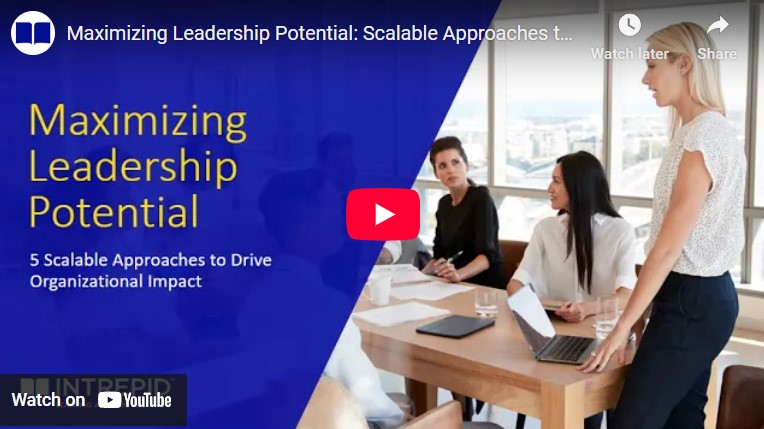
Discover how scalable leadership development helps healthcare organizations move beyond traditional programs to build stronger pipelines, improve engagement, and deliver measurable impact.
The Time to Act Is Now
Every day spent managing fragmented systems and delivering inconsistent experiences is another day talented, up and coming leaders look elsewhere for growth opportunities. Healthcare can’t wait: retirements, burnout, and turnover are accelerating, and without strong leadership pipelines, both patient care and workforce sustainability are at risk.
The good news? The technology and methodologies exist today to solve these problems. Organizations like BD are already leveraging Intrepid to scale leadership development with measurable results. And insights from leaders like Darci Hall at Kaiser Permanente highlight how forward-thinking approaches can make leadership both sustainable and impactful.
For L&D leaders, the first step doesn’t have to be a massive overhaul. Piloting a leadership journey tied to a measurable business priority—such as improving staff engagement, reducing turnover, or enhancing patient communication—can create proof of value quickly. Even modest improvements have significant financial impact: in healthcare, a 1% gain in retention can save tens of millions of dollars annually.
Whether you start with a focused pilot or reimagine leadership development across your entire health system, the key is taking that first step toward practice-based, AI-enabled, collaborative leadership journeys that scale across the enterprise and tie directly to measurable outcomes.
Ready to transform your healthcare leadership development? Explore Intrepid’s healthcare-specific platform capabilities and discover how leading health systems are building next-generation leaders at enterprise scale.
Learn from leading organizations: Listen to Kaiser Permanente’s insights on transforming learning in healthcare for practical strategies on scaling leadership development across complex health systems.
Frequently Asked Questions About Leadership in Healthcare
Why is leadership development important in healthcare?
Leadership development in healthcare is critical because retirements, burnout, and rapid change create gaps in leadership pipelines. Scalable, practice-based programs help health systems improve retention, ensure consistent patient care, and align leaders with organizational strategy.
What kind of leadership style is the most effective in healthcare?
The most effective leadership style in healthcare emphasizes empathy, adaptability, and evidence-based decision-making. Leaders who combine human skills with business acumen foster trust, support teams through change, and sustain performance in complex care environments.
What are the skills healthcare leaders need to develop to maintain cohesion and performance in a multi-generational workforce?
Healthcare leaders should build:
- Empathy and coaching skills to connect across generations
- Collaboration and inclusive leadership practices
- Agility and digital fluency to adapt to change
- Strategies that sustain engagement and unify performance
What strategies make healthcare leaders effective?
Effective healthcare leaders use strategies that blend collaboration, real-world practice, and continuous learning. Cohort-based programs, AI-powered practice, and missions tied to day-to-day responsibilities help leaders apply skills immediately and drive measurable outcomes like engagement and quality of care.