

Updated October 27th, 2025
Key Takeaways
- Collaborative, cohort-based practice with feedback is tied to stronger outcomes; high-performing orgs are far more likely to increase collaborative learning.
- Manager capability is now a business-risk lever; use manager programs to raise engagement and retention.
- Design around job-relevant application (not events): micro, multi-modal, spaced practice in the flow of work.
- Make progress visible with milestones, badges, and reporting to reinforce engagement.
Shaping the future of corporate leadership begins with transformative training approaches. Imagine a world where new managers are not just filling roles but nurturing a culture of collective success and team empowerment. This should be the essence of leadership training for new managers.
But here’s the sad reality: a shocking 63% of millennials feel their management skills are not being developed, leading them to question the growth opportunities at their workplaces and reconsider their loyalty. And it’s not just sentiment—according to the 2025 Work Institute Retention Report, management-related turnover is at a six-year high, with 9.7% of quits directly tied to management behavior and 63% of all exits deemed preventable (leadership, career, and work-life factors). When leaders lack essential skills, their team members are 3.5× more likely to consider leaving within a year.
This situation sends a strong message: we can’t rely solely on the old ways of instructor-led training (ILT) and virtual instructor-led training (VILT) anymore. So, what’s a forward-thinking L&D leader or Chief Learning Officer to do in this situation?
The answer lies in embracing change. That’s why we’re spotlighting collaborative learning and inventive leadership development methods. By making this shift, we move beyond mere knowledge transfer to foster an environment of shared growth and innovation — elements that are crucial for cultivating the leaders of tomorrow.
The importance of management training for new managers
Before we consider the specifics of successful leadership and development training and the role collaboration plays in it, let’s take a moment to grasp the broader context and dynamics that shape today’s managerial landscape.
Managerial roles in post-pandemic times
For sure, the workplace has undergone considerable change in recent years. Managers especially confront new challenges, as they need to adopt new leadership skills. For those new to management, staying up-to-date with the rapid pace of change can be intimidating, especially while they are still learning the rest of their job on the go.
Here are some of the responsibilities effective leadership now involves:
- Employee Well-being: Leaders must prioritize the emotional health of their teams. (Key skills: empathy, active listening, emotional intelligence)
- Remote Work Management: Adapting to remote and hybrid models has become a critical managerial skill. (Key skills: digital communication, team cohesion)
- Work-Life Balance: In this new era, managers aren’t just taskmasters; they’re guardians of work-life balance. (Key skills: time management, boundary setting, flexibility)
- Career Development: Increasing emphasis on personal growth means leaders must guide career pathways. (Key skills: talent development, career coaching)
- Inclusivity: A heightened focus on DEIA in the workplace requires managers to lead with inclusivity. (Key skills: equity advocacy, bias awareness, sense of justice)
So, it’s clear that the leadership style we need today goes beyond individual expertise and authority. It means moving towards new training and upskilling methods that further interaction, empathy, and collective growth – in short, a human-centered, collaborative approach.
Why more collaboration in training equals stronger business outcomes
If you’re curious about the link between collaborative and tangible business outcomes, our joint research with Training Industry offers some eye-opening insights. We surveyed 353 training managers and decision-makers, revealing that nearly half of all organizations are now focusing more on collaborative learning than in previous years. Interestingly, high-performing organizations (HPOs) are 5.5 times more likely to intensify their collaborative learning use than low-performing organizations (LPOs).
And they’re wise to do so. As our research shows, key benefits of using collaborative training methods include:
- 56% More Efficient Learning
- 54% Better Skill Development
- 52% Greater Engagement
- 50% More Effective Career Progress
- 50% Better Business Goal Alignment.
Want to see some of those results for yourself? Explore more details in our Collaborative Learning and Performance white paper.
5 key components of effective leadership training programs
Now that we’ve established the importance of collaborative learning, let’s see how this plays out in the context of online leadership development and explore what other related elements are essential for a successful training program.
1. Cultivating collaborative learning and peer interaction
As mentioned, nearly half of all organizations we surveyed increased their collaborative learning initiatives within the past two years. In 2025, APQC’s Communities of Practice survey underscores that communities and networks remain central to promoting knowledge-sharing practices across organizations—making peer-based learning a core lever of culture and performance.
When leadership training prioritizes collaborative learning, participants gain richer perspectives and innovative solutions from diverse experiences, stay highly engaged and motivated through active participation and peer support, hone essential skills like communication and problem-solving in a safe space, build trust and lasting professional networks, and solidify their learning by applying it with peers.
Collaboration can be fueled by discussion forums, live chat, workspaces, social profiles, and group projects. This approach empowers leaders to not just acquire and retain knowledge, but to co-create their development journey and emerge as effective and connected leaders.
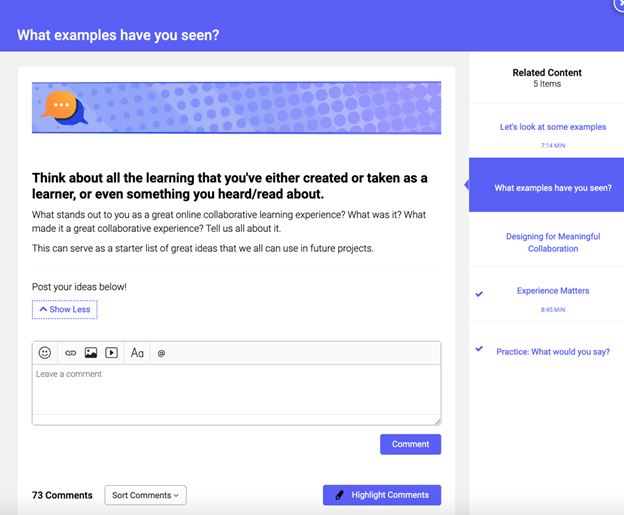
Collaborative learning can be cultivated through group activities and rich discussions where emerging leaders can actively engage with each other, share knowledge, and solve problems together.
2. Emphasizing emotional intelligence and empathy
Effective leadership goes beyond technical skills and strategic thinking. It requires a deeper understanding of oneself and others, the ability to connect authentically, and navigate emotions skillfully. According to an EY US Consulting Study, 86% of employees see empathetic leadership as a morale booster. Plus, 87% say empathy is crucial for cultivating an inclusive work environment.
Consider this scenario: A young team leader faces her first major project with a tight deadline. Amidst rising tension and noticing team members feeling overwhelmed, she calls a meeting. Here, social skills training can help her open the floor for honest communication and realign tasks to ensure everyone feels heard and supported.
A focus on emotional intelligence and empathy in a leadership training program can take the form of self-assessments to identify areas for development, role-playing and simulations, group discussions on case studies and real-world examples, mindfulness and well-being exercises, and feedback and coaching to support growth. With emotional intelligence at the forefront, leaders are better equipped to handle tough situations, build stronger team relationships, make well-rounded choices, and increase their self-awareness to manage stress and lead with authenticity.
3. Incorporating real-world scenarios and practical learning
Good leadership development hinges on practice-oriented experiences where learning transcends the theoretical.
This requires solving real-world problems through practical learning. This strategic approach encompasses seamless and immediate integration in the flow of work. Aspiring leaders excel when learning effortlessly aligns with their daily tasks, combined with the opportunity to reflect on what they’ve learned and share that experience with peers..
For example, missions, projects, and video assignments create a practical playground to translate theoretical learning into tangible action. Then through the use of discussion forums, workspaces, AI-based feedback, and peer reviews, learners can collaboratively tackle challenges, foster shared insights, demonstrate their knowledge, and create a culture of improvement. This variety can improve engagement rates and equips leaders with versatile skills, ensuring adaptability and readiness to tackle a variety of leadership challenges.
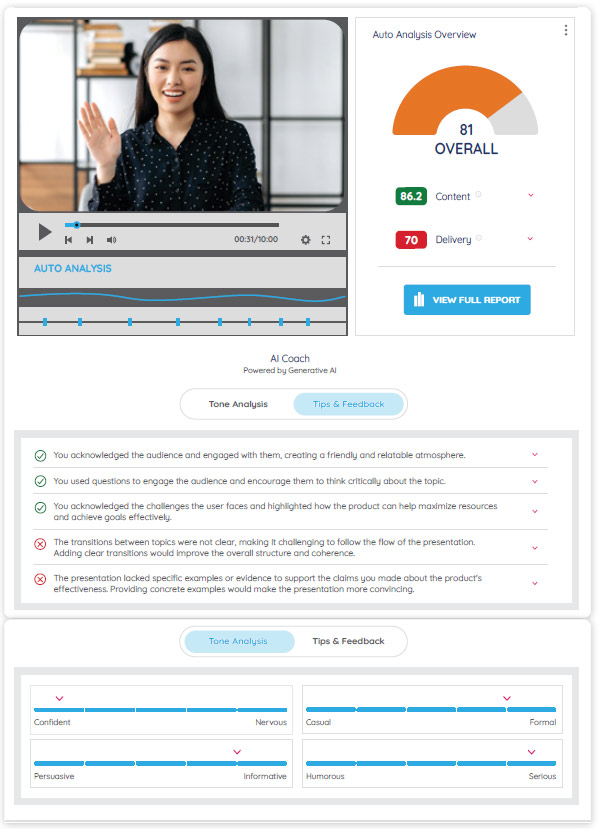
Intrepid’s AI Video Assessments deliver consistent and scalable feedback to accelerate skill development and real-time implementation on the job.
4. Using multi-modal content to deliver personalized, microlearning journeys
In leadership training, diversity reigns supreme – for example, a rich variety of microlearning assets such as videos, audios, images, links, and quick-read documents. It’s this blend of microlearning tools that fosters adaptable, on-the-go learning. Every asset, from a brief audio snippet to an in-depth article, shapes a leader’s journey, making learning a personalized, everywhere experience.
A quick look at microlearning statistics confirms the effectiveness of this approach:
- Learner preference/personalization: 91% of employees want training customized to their needs and 93% want it kept simple—preferences microlearning is built to meet.
- Retention: Microlearning has been found to improve knowledge retention by up to 60% (and bite-sized visual modules show ~20% better retention vs. other formats).
- Self-paced/on-your-time: Most learners prefer to learn on their own time—58% say they’re more likely to engage when content is broken into short segments, and mobile microlearning can cut training time 45–80%.
This suggests that microlearning potentially plays a key role in leadership retention, as it keeps learners engaged, challenged, and fulfilled, no matter where they are in their career path or how their leadership roles evolve.
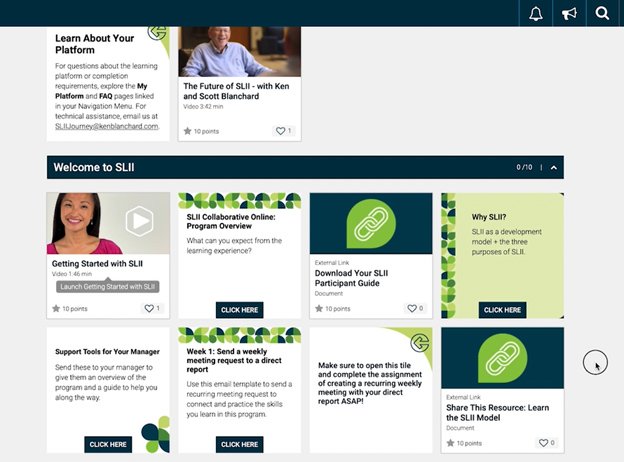
Blanchard’s flagship leadership program, SLII®, uses multi-modal content to meet a wide range of delivery and learner needs.
5. Elevating learner motivation through gamification and progress tracking
Gamification and progress tracking are other key components in innovative online leadership development training. Think about it: Earning points on a leaderboard and badges for completing assignments and social participation, such as in discussion forums, injects fun into learning. Quizzes aren’t just assessments; they become exciting milestones, reinforcing what’s been learned.
This approach taps into emotions directly. When learners connect with content that stirs feelings – whether it’s the thrill of a challenge or the satisfaction of solving a problem – engagement deepens. Emotional connections in learning, like recalling personal experiences in discussions, make the material more relatable and memorable, turning routine training into an emotionally resonant journey.
So, if you want to implement leadership best practices that improve employee engagement, consider how each interactive element can cultivate stronger emotional connections.
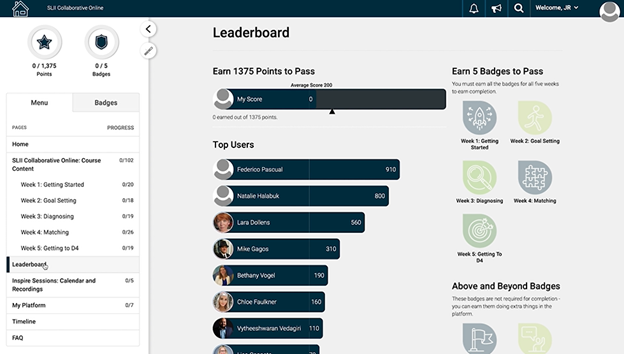
Blanchard utilizes gamification so participants can track progress against their broader cohort and their small groups (if applicable) to help drive engagement in their flagship leadership program, SLII®.
Cohort-based leadership development program examples
Having explored the essential elements of active leadership training, let’s now see these concepts in action through Intrepid’s cohort-based learning solution, designed to foster interaction and collaborative problem-solving in a timebound blended, digital format.
Here are three impactful leadership training examples:
Case study 1: Scaling a Manager Development Program
Grant Thornton redesigned its Manager Development Program into a cohesive, skills-first journey with cohort practice, career-aligned milestones, right-time scheduling, and clear progress visibility—strengthening engagement, consistency, and on-the-job behavior change.
The challenge
Disconnected sessions made it hard to build coaching habits, peer connections, and sustained engagement (hovering ~50%). The team needed a centralized way to run a year-long path, coordinate cohort activities with feedback, and track progress to secure leadership support.
The solution
Grant Thornton consolidated scattered sessions into a single year-long journey with clear, career-aligned milestones. Managers cycled through short on-the-job missions and live virtual role-plays, with cohorts giving peer feedback and tracking progress via reporting, quarterly check-ins, and meaningful badges timed to business rhythms.
The shift stabilized participation and lifted outcomes: live sessions held 90% attendance, completion rose to 83% (from 36%), learners rated skill impact 4.4+/5, and program NPS hit 53—evidence that practice, timing, and visibility drove engagement and behavior change.
Case study 2: Culture change at scale
A global consumer goods manufacturer needed to shift from a holding company to a unified global operator. They achieved this through large-scale leadership development.
The challenge
The company’s transformation involved more than structural change; it required a cultural shift across 9,000 employees globally. The task was to embed a new business strategy and corporate values, moving beyond traditional learning methods to make these concepts clear and actionable for every employee.
The solution
Intrepid’s learning experience platform blended insights from top-tier business schools with company-specific content, making learning practical and aligned with everyday tasks. Key features such as online discussion forums and practical missions proved essential. The program, which engaged 800 senior managers in its initial phase, led to immediate cultural shifts and high employee satisfaction ratings, with user interaction scoring 4.85/5 and overall learning effectiveness at 4.81/5.
Case study 3: Leaders-as-teachers at Scale
Becton Dickinson‘s quest for leadership excellence required transforming the skills of many, rapidly due to company growth. Facing a substantial increase in managerial roles, they partnered with Blanchard, utilizing their services through the Intrepid learning platform.
The challenge
After two major acquisitions, BD needed to rapidly equip a 200% larger manager population with a consistent, culture-aligned skill set—moving beyond resource-intensive, in-person training to something global, scalable, and modern.
The solution
BD partnered with Blanchard to curate content across courses and assembled a 12-week blended journey: short 3–15 minute modules, small-group discussions, digital simulations, project work, and large, interactive virtual sessions—all delivered in cohorts. Senior leaders facilitated the live sessions, reinforcing a “leaders give back” ethos and the idea that people learn concepts more deeply when they teach them. The experience was BD-branded, mapped to The BD WAY, and used badges to celebrate milestones and sustain momentum.
The outcomes of this journey were striking:
- Program value and advocacy: 100% would recommend the program and said they learned something valuable.
- Capability gains at finish: 91% clarity on manager expectations; 90–94% reported stronger skills (flexing style, psychological safety, self-awareness).
- 6-month sustainment: 100% said they learned new skills, applied them on the job, improved team performance, and felt more engaged as leaders.
- Retention and specific skill lifts: 85% more committed to stay; significant improvements in listening (54%), attentiveness to individuals/emotions (77%, 25% felt exceptional improvement), adapting their leadership style to meet each team member’s needs (69%), and team cohesion (54%).
Together towards tomorrow: Let’s build a community of emerging leaders
In this exploration of leadership development best practices, we’ve uncovered how crucial it is for new managers to engage in collaborative and interactive learning experiences. Intrepid’s platform exemplifies this approach, blending cohort-based digital learning with practical application to develop truly connected, empowered, and forward-thinking leaders.
Discover how Intrepid can transform your leadership training. Book a demo and start shaping the leaders of tomorrow, today.
Frequently asked questions about leadership training for new managers
How do you train a new manager in leadership?
Train new managers collaboratively, highlighting peer interaction, emotional intelligence, and applied learning to optimize engagement, skill development, and better business outcomes.
What are 5 steps for developing managers into leaders?
Here are 5 steps to include in a leadership development program for developing managers into leaders:
- Cultivate collaborative learning and peer interaction
- Emphasize emotional intelligence and empathy
- Incorporate real-world scenarios and practical learning
- Use multi-modal content to deliver personalized, microlearning journeys
- Elevate learner motivation through gamification
What is a leadership training example?
A leadership training example involves an organization implementing collaborative learning for their leadership development program with multi-modal tools such as online modules, webinars, interactive discussions, and group activities to address leadership skill gaps. Benefits to this approach also include increased engagement and completion rates, and improved behavior in critical areas such as relationship building and inclusivity.