

Completion tells you who did the training. It doesn’t tell you who can handle the call. Here’s how to close the agent readiness gap before the Annual Enrollment Period begins.
Key Takeaways
- Most health plans equate training completion with agent readiness. Those are two different measures, and October 15 is when that gap becomes visible in live member calls.
- Across large payers, personalized onboarding is a consistently unmet need. Training every agent to the lowest common denominator slows capable hires and drives early attrition.
- Health plan operations leaders can close the readiness gap before AEP by shifting from completion tracking to performance-based readiness: assess specific capability gaps, target practice to those gaps, and reassess before the phones go live.
Picture the first week of the Annual Enrollment Period (AEP). The phones are lit up. A member calls in holding a notice they got in the mail, and asks the question every health plan agent will hear some version of this fall: “My benefits are changing next year. Am I going to pay more?”
Now ask a harder question. Every agent taking those calls finished their AEP training. But can they handle the conversation?
Those are two different questions. Most health plan operations teams can answer the first one with a dashboard. Far fewer can answer the second.
That gap between “trained” and “ready” is the real risk heading into AEP.
What Health Plan Operations Leaders Are Measuring
Here’s how readiness usually gets decided. Training gets assigned. People complete it. They pass a quiz. And somewhere in there, we quietly make the leap to “they’re ready.”
Completion data is useful. You need to know whether people went through the required material. But completion answers a narrow question: did they do the training? It doesn’t answer the one that matters during AEP: can they perform?
In many member services organizations, readiness isn’t determined, it’s assumed. Time in program becomes the proxy. The training calendar becomes the readiness plan. And by the time anyone questions whether agents can perform, the phones are already live.
An agent might know a benefit changed. They might even answer a multiple-choice question about it correctly. Then a member says, “I don’t understand this notice. Am I going to have to pay more?” and the job changes. Now the agent has to understand the member’s real concern, explain the benefit in plain language, decide the right next step, know when to escalate, and stay inside compliance boundaries.
That’s the difference between knowing information and being ready to use it. Real readiness takes four things training completion doesn’t measure: application, judgment, communication, and compliance.
The Personalization Problem Underneath the Readiness Gap
There’s a second issue sitting beneath the completion problem, and it compounds the first: most onboarding programs are built for the least-prepared person in the room.
Agents who arrive more capable are slowed by material they’ve already mastered, while agents who need more support move through the same content at the same pace. Neither group is well-served.
This matters for AEP specifically because of the populations health plans bring in seasonally. When your AEP hiring cohort includes tenured Medicare agents and people new to healthcare, running them on the same path doesn’t serve either group. It leaves readiness gaps in the agents who needed more practice, and it drives early attrition in the agents who could have reached proficiency faster.
According to Deloitte’s 2026 Global Contact Center Survey, the employee attrition rate in contact centers averages 38%. McKinsey estimates each agent replacement costs between $10,000 and $20,000. For a 100-agent AEP operation, that’s between $380,000 and $760,000 a year in replacement costs alone, partly because capable hires never found their footing before they left.
The goal isn’t just faster onboarding. It’s continuous upskilling that keeps pace with a role that keeps changing.
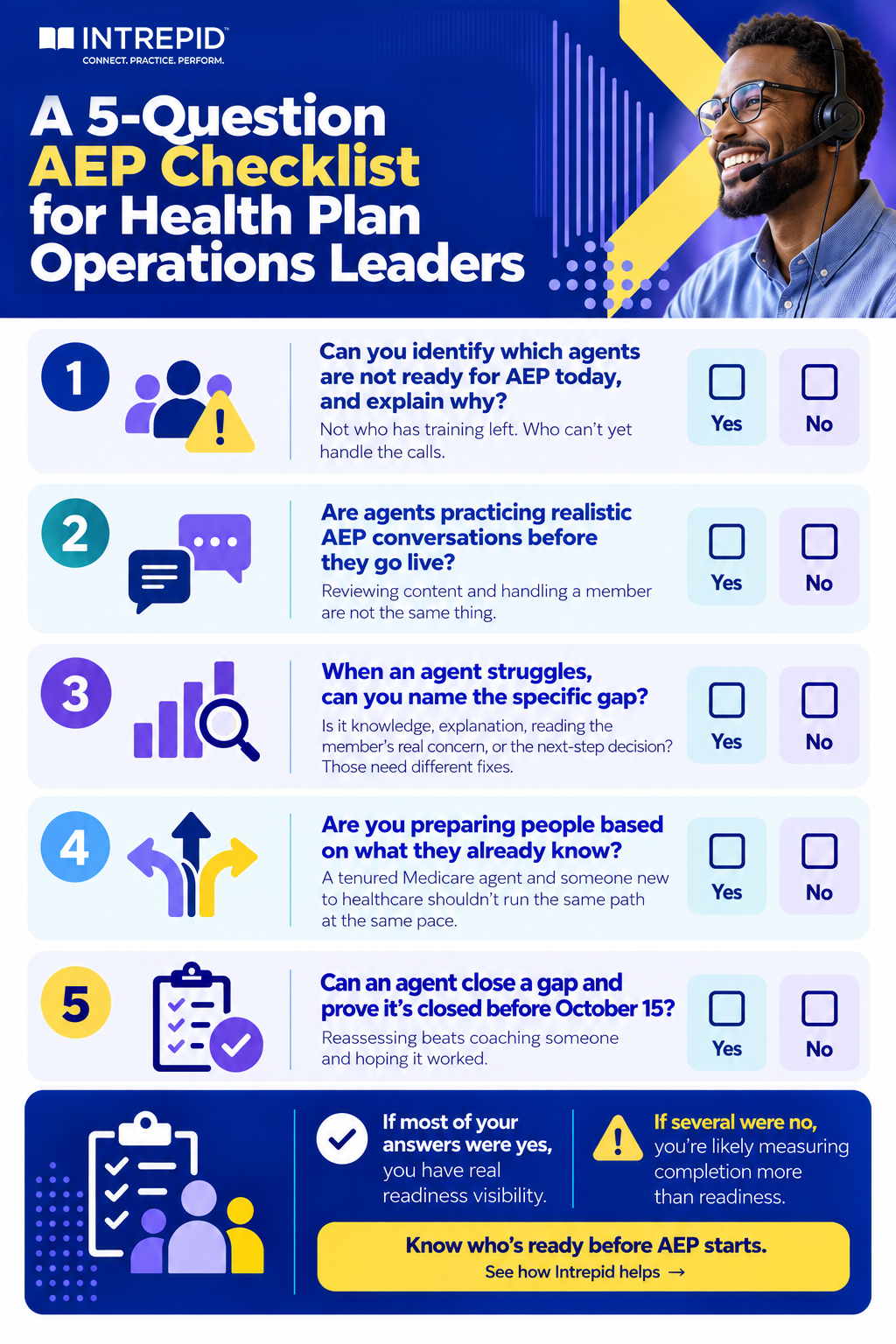
A Health Plan Operations Checklist: 5 Questions Before October 15
Want a quick gut check on your AEP preparation? Here are five key questions to answer.
- Can you identify which agents are not ready for AEP today, and explain why? Not who has training left. Who can’t yet handle the calls.
- Are agents practicing realistic AEP conversations before they go live? Reviewing content and handling a member are not the same thing.
- When an agent struggles, can you name the specific gap? Is it knowledge, explanation, reading the member’s real concern, or the next-step decision? Those need different fixes.
- Are you preparing people based on what they already know? A tenured Medicare agent and someone new to healthcare shouldn’t run the same path at the same pace.
- Can an agent close a gap and prove it’s closed before October 15? Reassessing beats coaching someone and hoping it worked.
If most of your answers were yes, you have real readiness visibility. If several were no, you’re likely measuring completion more than readiness.
What Readiness Looks Like
The model for closing the gap is simple to say: assess, diagnose, practice, reassess, ready. The important part is that readiness isn’t a box you check once at the end. It’s a cycle.
Start by assessing what an agent can actually do in a realistic situation, not just what they remember. Then diagnose the gap. Say an agent answers a benefit-change question correctly on paper, then freezes in a live-style conversation. Maybe they lean on plan jargon. Maybe the answer is accurate but the member is still confused. Maybe they never address the worry underneath the question.
That tells you something specific: this isn’t a knowledge gap. The agent knows the answer. The gap is in how they explain it. So the fix isn’t the entire AEP curriculum again. It’s targeted practice on plain-language explanation, then a reassessment in a different scenario that calls for the same skill. Once they can do it consistently, you have evidence they’re ready.
From Completion Data to Readiness Intelligence
Most organizations can already show you something like this: 94% of AEP training complete, plus an average quiz score. Useful. But it leaves the big question open. Who’s really ready?
Now imagine a different view. Instead of a completion percentage, you see 182 agents ready, 31 nearly ready, 14 who need intervention, and 3 with a high-risk gap that needs attention now. Underneath that, the most common gaps by name: benefit-change explanations, formulary navigation, escalation decisions, plain-language communication.
That’s the shift from completion data to readiness intelligence. One tells you who finished. The other tells you where to act.
What Readiness Gaps Cost
A readiness gap shows up as an operating cost in three predictable places: turnover, ramp time, and coaching capacity.
Turnover. Contact centers already run hot, with annual turnover often in the 30 to 40 percent range. McKinsey estimates replacing a contact-center agent costs roughly $10,000 to $20,000 per person. For a 100-agent operation, that’s somewhere between $300,000 and $800,000 a year. Readiness doesn’t erase turnover. But underprepared agents who lean on supervisors and never quite find their footing are harder to keep, and when someone leaves before reaching proficiency, you lose everything you invested getting them there.
Ramp time. For UnitedHealthcare’s Medicare Appeals and Grievances program, time to proficiency dropped from nine months to six weeks after moving their onboarding program to an applied learning approach. That’s roughly 33 weeks of productive capacity recovered per new hire. At a fully loaded cost of around $58,000 for a member services role—based on Salary.com wage data and BLS employer-compensation ratios, where wages account for approximately 70% of total employer cost—those 33 weeks represent about $37,000 of capacity per person reaching proficiency sooner. Across a 100-person cohort, that’s close to $3.8 million.
One honest note on that number. It isn’t $3.8 million in cash savings. Those employees are still on payroll. The value is that they’re contributing at a much higher level, much sooner. Where faster proficiency lets you delay additional hiring, some of it becomes real avoided cost. Either way, every week between “training done” and “can do the job” has value.
Coaching capacity. McKinsey estimates an average 500-agent North American contact center spends roughly $2 million a year in staff time on coaching. The question isn’t whether to coach. It’s whether that time lands where it matters. If every agent gets the same cadence and the same topics, that’s an expensive way to operate. Readiness lets managers spend their hours on the agents and the gaps that carry the most risk.
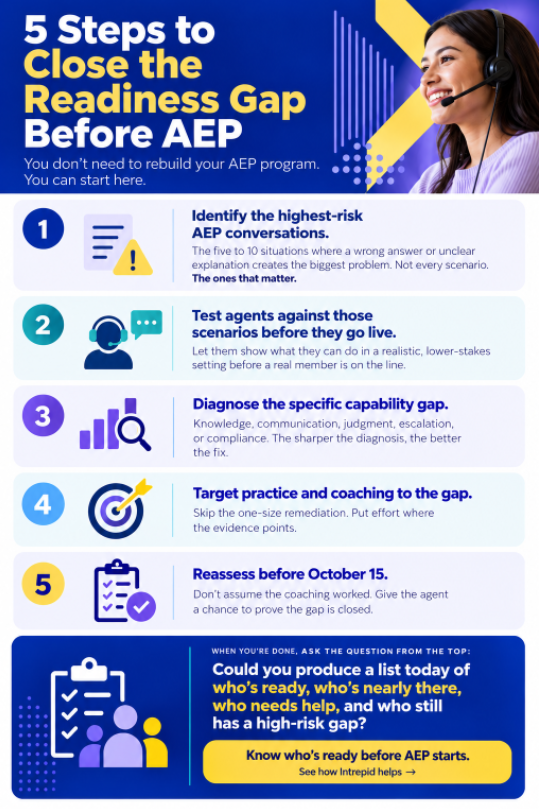
5 Steps to Close the Gap Before AEP
You don’t need to rebuild your AEP program. You can start here.
- Identify the highest-risk AEP conversations. The five to 10 situations where a wrong answer or unclear explanation creates the biggest problem. Not every scenario. The ones that matter.
- Test agents against those scenarios before they go live. Let them show what they can do in a realistic, lower-stakes setting before a real member is on the line.
- Diagnose the specific capability gap. Knowledge, communication, judgment, escalation, or compliance. The sharper the diagnosis, the better the fix.
- Target practice and coaching to the gap. Skip the one-size remediation. Put effort where the evidence points.
- Reassess before October 15. Don’t assume the coaching worked. Give the agent a chance to prove the gap is closed.
When you’re done, ask the question from the top: could you produce a list today of who’s ready, who’s nearly there, who needs help, and who still has a high-risk gap?
The Real AEP Readiness Standard
So, is your team AEP-ready? Not trained. Not complete. Ready. Can they handle the conversations coming their way, apply what they know, make sound judgment calls, and explain things clearly inside the right compliance boundaries? And can you see, before October 15, who’s ready and who isn’t?
This is the problem Intrepid by VitalSource is built to solve. Most learning technology delivers content or completions. Intrepid builds capability through practice, feedback, and coaching. For healthcare member services teams, that means assessing real performance against realistic scenarios, diagnosing individual gaps, targeting practice and coaching to those gaps, and giving health plan operations leaders a clear view of where risk still lives. AI is part of how that scales: it powers realistic practice and faster feedback. It works alongside the human coaching that makes skill stick, not in place of it.
The aim is straightforward. Spot the gaps before they show up on a live member call.
If you’re working through AEP readiness this season, we’d like to show you how health plans are using Intrepid to close the gap and talk through what that could look like for your operation.
Frequently Asked Questions About Agent Readiness in Health Plan Operations
What does “agent readiness” mean in health plan operations?
Readiness means an agent can perform in a real member conversation, not just recall what they learned in training. A ready agent understands what the member is worried about, translates benefits into plain language, makes the right next-step decision, and stays within compliance boundaries. Completion percentages measure whether agents went through training. Readiness measures whether they can do the job.
How do health plans know if agents are ready for AEP?
Most don’t have a reliable way to tell. Across large payers, readiness is typically assessed through training completion and quiz scores, which measure knowledge recall, not real-world performance. The organizations best positioned for AEP can name specific capability gaps by agent and show that those gaps were addressed and verified before October 15.
What is the cost of agent attrition for a health plan contact center?
According to Deloitte’s 2026 Global Contact Center Survey, average annual attrition in contact centers is about 38%. McKinsey estimates each agent replacement costs between $10,000 and $20,000. For a 100-agent member services operation, that’s roughly $380,000 to $760,000 a year in replacement costs, before accounting for the productivity lost while new agents ramp. For larger AEP operations, the number scales quickly.
What does slow agent ramp time cost a health plan?
Every week between “training done” and “ready to perform” has a cost. Based on Salary.com wage data for health plan member services representatives and BLS employer-compensation ratios—where wages account for approximately 70% of total employer cost—fully loaded annual compensation for a member services role runs roughly $58,000–$60,000. Each week of ramp time represents real labor that isn’t yet returning full value.
For UnitedHealthcare’s Medicare Appeals and Grievances program, time to proficiency dropped from nine months to six weeks, roughly 33 weeks of productive capacity recovered per new hire. At that compensation range, those 33 weeks represent approximately $37,000–$38,000 of capacity per person reaching proficiency sooner. Across a 100-person cohort, that’s close to $3.8 million.
That number isn’t $3.8 million in cash savings as those employees are still on payroll. The value is that they’re contributing at full capacity much sooner. Where faster proficiency allows hiring to be delayed, some of it becomes real avoided cost.
How should Medicare Advantage plans prepare member services agents for AEP?
The most important step is moving from content-based preparation to performance-based readiness. That means testing agents against realistic AEP conversations (benefit changes, formulary questions, plan comparisons, escalation decisions) before they take live calls, diagnosing capability gaps, targeting practice to those gaps, and reassessing to confirm they’re closed before October 15. Completion rates tell you who went through training, but realistic practice under scenario conditions tells you who can handle the conversation.
How should a health plan onboard new member services agents faster without sacrificing readiness?
Personalization is the most direct route to faster ramp without a readiness tradeoff. When every agent runs the same path at the same pace, capable hires slow down and agents who need more support don’t get it. The better approach starts by assessing what each agent already knows, then focusing onboarding time on the specific gaps that stand between them and real performance. Closing only the gaps that exist is faster than re-covering material that’s already in place.
How can personalized onboarding reduce ramp time for health insurance agents?
Training every agent to the lowest common denominator is one of the most common and costly onboarding mistakes in health plan contact centers. Personalized onboarding identifies what an agent already knows, removes redundant content, and focuses their time on the specific gaps that affect their ability to perform. A tenured Medicare agent and someone new to healthcare don’t need the same path. When onboarding adjusts to the individual, capable agents reach proficiency faster, and agents who need more support get it rather than being carried along by a fixed program timeline.
How can health plans reduce time to proficiency for new contact center agents?
The biggest lever is realistic practice before live calls. Most agent onboarding is built around content review and knowledge checks, neither of which prepares an agent for a real member conversation. Scenario-based practice followed by specific feedback and reassessment compresses the gap between “training complete” and “ready to perform.” It also makes the coaching investment more precise: instead of coaching everyone on the same topics, managers can focus on the agents and the specific gaps that carry the most risk heading into AEP.
What is the best way to train healthcare payer call center agents for complex member conversations?
The most effective preparation is realistic practice before the call, not content review after it. Complex member conversations during AEP require more than accurate information. They require the ability to identify what the member is actually worried about, translate benefits into plain language, make the right next-step decision, and stay within compliance boundaries. Those skills develop through practice with realistic feedback, not through completing modules. Preparing agents against the five to 10 highest-risk AEP conversation types, with specific diagnosis and follow-up, is the most direct path to performance readiness.
How should a health plan calculate ROI from faster contact center agent onboarding?
Start with three variables: the fully loaded cost of a member services role (salary plus benefits loading), the time difference between your current ramp and a faster ramp target, and the size of your hiring cohort. Multiply the weeks recovered by the weekly fully loaded cost per agent, then multiply by cohort size. That gives you the productive capacity recovered. Where faster proficiency lets you delay additional headcount, some of that becomes hard avoided cost. McKinsey’s estimate of $10,000 to $20,000 per agent in replacement costs provides a separate calculation for the attrition-reduction value. Both figures belong in a complete health plan operations ROI model for onboarding improvement.
What’s the difference between agent training completion and agent readiness in health plan operations?
Completion tells you an agent went through the required content. Readiness tells you they can perform in a real member conversation. An agent can complete every AEP module, pass every knowledge check, and still struggle when a member uses unexpected terminology, expresses frustration, or asks a follow-up question the training didn’t anticipate. Readiness is demonstrated through realistic practice under conditions that resemble actual calls, not through completion percentages. For health plan operations leaders, this distinction is most visible during AEP, when every agent is taking high-stakes calls from day one.
Why do health plan contact centers struggle with high attrition around AEP?
Two patterns drive most of it. Agents who weren’t fully ready for the call volume and complexity of AEP struggle early and leave before they’ve recovered the investment made in their onboarding. And capable agents who move through a one-size program faster than it was designed for often arrive underprepared for actual complexity, because the program was built for the least-ready person in the cohort. Both are solvable with a readiness-based approach that adjusts to what each agent needs and verifies capability before they go live.
How does health plan operations leadership build a business case for onboarding improvement?
The most credible business cases combine three cost drivers: ramp-period productivity loss (fully loaded cost × weeks to proficiency), annual attrition (replacement cost × turnover rate × headcount), and coaching capacity (staff hours × average cost). Improvements to any of the three show up on the P&L. For health plan operations leaders presenting to a CFO or COO, framing the investment in terms of recovered productive capacity and reduced replacement cost is more compelling than a learning outcomes argument.