In Short…
- A continuous feedback loop in corporate L&D is a structured process for gathering insights, improving learning programs, and connecting training to measurable business impact.
- Effective feedback systems help L&D teams move beyond one-time surveys by continuously listening, adjusting, and responding across the full program lifecycle.
- When done well, continuous feedback loops strengthen learner engagement, drive behavior change, and demonstrate the real value of learning to stakeholders.
Continuous learning isn’t just for learners, it’s for L&D teams, too!
When a learning program launches, if we just set it and forget it, we’re missing a huge opportunity. We can’t stop there without expecting the same response from learners.
If we want to create the best possible learning out there, then we as designers have to keep learning. If we’re to really motivate learners to keep coming back, and dig in to engage at a high level, we’ve got to do that, too. One way to do that is by continually listening, learning, adjusting, and responding with intention.
That’s where continuous feedback loops come in.
What Is Continuous Feedback in L&D?
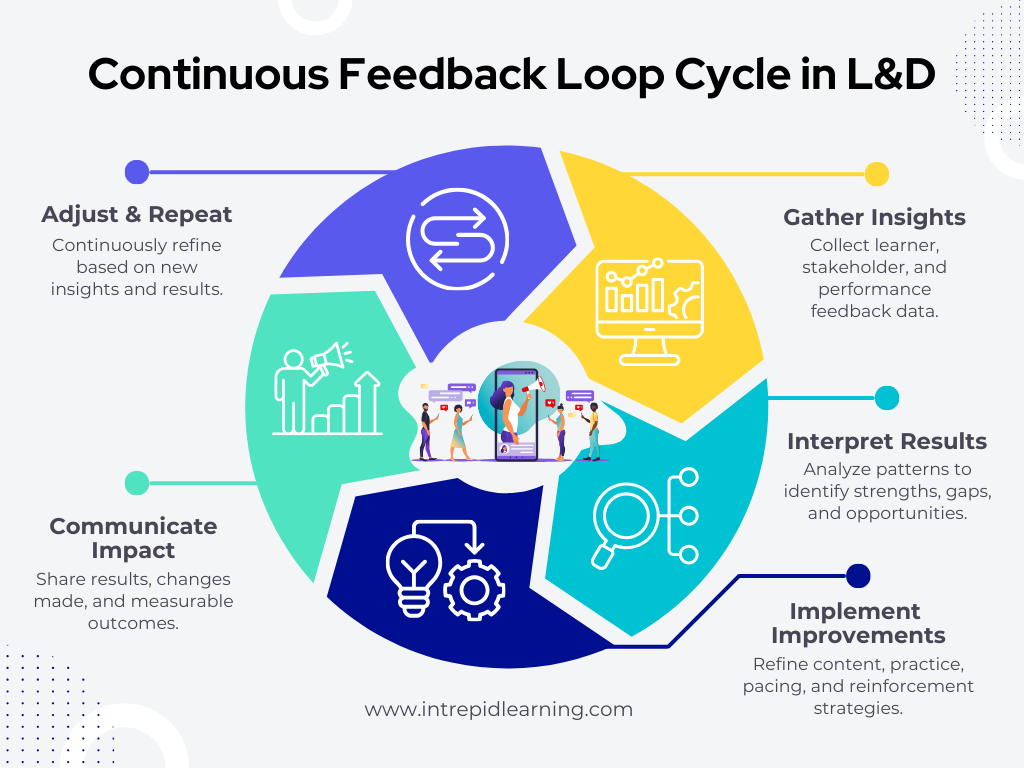
A continuous feedback loop is essentially an ongoing process that involves these 5 steps:
- Gather insights
- Interpret what those insights tell us
- Use those insights to inform and implement meaningful changes
- Close the loop by following up with the impact and the audience
- Adjust and repeat over time
Staying in the loop involves talking to people: stakeholders who set expectations, peers who weigh-in to share expertise, learners who experience the work firsthand, and business partners who see the longer-term impact. This process can tell us where things succeed, where they fall short, and how we can adapt in important ways. The final steps of the loop connect it back to the people who care. Then we can adjust, repeat, and continue building momentum.
Why are Feedback Loops Important in Training
Effective feedback loops in development and training cycles don’t just give you more information. They keep you more connected to the people your learning serves. Feedback loops create a continuous improvement cycle that offers learning teams several key advantages.
Continuous Feedback Benefits
- Surface what’s happening for learners
What you hoped a learning program would achieve doesn’t always turn out as planned. Hearing directly from learners gives you a clearer picture of what’s happening in their actual learner experience. That also creates opportunities for greater learner engagement, and stronger social, collaborative learning.
- Inform meaningful improvements
By pinpointing what’s working and what’s not you, you add to the strengths and address the shortcomings. Bringing peers into the loop helps uncover blind spots you may have missed.
- Connect learning to real impact
Follow-up with learners and business partners allows you to track down when and how change is showing up on the job. That means you can validate whether goals are being met by building a case for the impact.
- Strengthen relationships with stakeholders and partner
Feedback loops create a thread through the organization by doing the accounting on the work of learning teams, the results learners achieve, and the impact stakeholders see. This reinforces relationships within the organization and solidifies the value of learning to the business.
The most valuable insights rarely show up in a single metric or survey. They come from patterns, the trends that emerge when we gather, analyze, and act on feedback over time. That turns guesswork into informed understanding.
Feedback Loops for Learning Teams
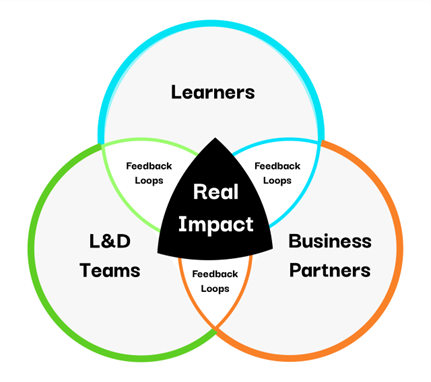
Start thinking about feedback loops and who’s involved before the design of a new program. Achieving success means starting as early as the discovery stage with a strategy that fuels improvements and real impact.
Learner Experience and Program Improvement
Learners help you understand how the experience landed and what to improve based on results like learning behaviors, sentiment, ratings, and comments. This loop helps you respond with improvements while staying learner centered.
Consider asking:
- What do we want to learn about the learner experience?
(e.g., behaviors, sentiment, confidence, the good, bad, and how to improve)
- How will we use the info to improve the program, and who will weigh-in?
(e.g., refine application and practice, reinforce key concepts, adjust pacing)
- Which methods will help us capture the right data at the right time?
(e.g., usability, pilots, polls, outgoing surveys, engagement data)
Performance and Business Impact
Stakeholders and business partners help clarify goals from the start and confirm whether the learning delivers on them later. People closest to learners on the job, including learners themselves, can provide input on how the learning is driving change. This loop keeps the program grounded in the goals that matter most and follow up on the impact.
Consider asking:
- What are the business goals and what does “successful impact” look like?
(e.g., fewer errors, faster employee onboarding, higher satisfaction, better KPI or bottom line)
- Is that impact measurable, and who can reliably report on it?
(e.g., learners, business partners, managers, supervisors, data owners)
- How will we gather and interpret that information?
(e.g., input from business partners, manager feedback, performance dashboards)
As the program evolves, so can your feedback loops. Don’t be afraid if plans change, because the whole point here is that once you’ve gathered more information, you’ll plan on making changes.
Expert Framework: How Feedback Loops Evolve Across the Program Lifecycle
The best learning rarely strikes gold on the first try. That’s why improvement through small, insight-backed adjustments over time matters so much.
To avoid designing in the dark, start with a simple roadmap. Mapping your feedback strategy across the life of a program clarifies what to focus on and helps you work more efficiently. Put your approach into the context of specific priorities.
Early on, you may care most about program improvement:
- What’s unclear?
- What’s confusing or less valuable?
- Where do learners engage most or least?
Later, as the program matures, you may shift focus more towards results:
- How are learners applying new skills?
- What impact is the business seeing?
Think of this roadmap as your guide for gathering early wins, and signs for improvements, then refining the experience, capturing real results once the program is in motion, and building the story of long-term impact.
1. Pre-Pilot / Early Design: Catch blind spots before a full cohort ever sees the learning.
Early feedback during design helps you test assumptions and uncover unknowns. Walk through your design with a few prospective learners, SMEs, or stakeholders. Early conversations reveal real needs and friction points you can fix before they become bigger problems later.
Methods: Voice-of-the-learner (VOL), SME and stakeholder reviews.
2. Pilot: Adjust and strengthen the overall experience.
A pilot program puts small group through the overall experience and invites their honest feedback. Make it clear to participants that this is a pilot, and that their feedback matters. You can gather frequent, open-ended feedback to understand what lands well, or what doesn’t, and look for gaps you didn’t anticipate. This is your moment to adjust and strengthen before scaling up.
Methods: In-course polls (pulse checks), post-pilot survey or focus group.
3. Launch / Go Live: Fine tune the full experience and gather results.
Once the full experience is live, you can gather more data to learn from real behaviors and engagement patterns. Post-launch feedback may still show what’s working, what needs attention, and should now help you see how the learning is showing up on the job through behavior change, skills application, or performance gains.
Methods: Program reporting and analytics, pre/post-course survey, follow-up questionnaire.
4. Future Cohorts / Iterations: Continue improvements and measure impact.
Each new cycle in a continuous feedback loop adds insight into improvements and impact. helping you understand how consistently the program achieves its intended outcomes. Over time, consistent results help prove value. Improvements may slow as the program matures, but continuous feedback keeps you aware and ready for change.
Methods: Follow-up surveys, manager input, performance dashboards, ongoing analytics.
Keep the Training and Feedback Loop Going
Let curiosity lead. When learners are heard through a continuous feedback system, you can ensure learning stays relevant. Build feedback loops into your process, and every iteration will strengthen your learning while keeping it aligned with real people and real priorities.
- Keep asking
- Keep listening
- Keep adjusting
- Keep showing learners, peers, and partners that their input matters
- Keep learning
Keep fueling improvement and real impact!
Dive Deeper
If you want to explore continuous improvement feedback loops further, you’ll find plenty of practical guidance in the worlds of product design and user experience as well. Just exchange the concepts of learners and stakeholders with that of end users and customers.
From Feedback to Action: Building a Continuous Improvement Process for Training Programs
Source: Management Concepts
Consistent feedback supports smarter training decisions and ongoing refinement. Useful for learning designers who want to turn learner and stakeholder input into measurable improvements over time.
Design Feedback Loops: Examples and Best Practices for Creatives
Source: Ziflow
Feedback loops improve quality, collaboration, and delivery speed. In high-impact programs, feedback is built into the rhythm of learning through facilitator input, learner performance, and team retros, so experiences can continuously evolve and improve.
How to Build Effective Product Feedback Loops
Source: Who’s Your ADDIE
Break down feedback loops from collecting input to acting on it and communicating results back. Helpful for emphasizing loop closure, trust-building, and visible progress through real change.
Mastering the Product Feedback Loop
Source: Formbricks
Focus on listening, acting, and responding in order to reduce guesswork. This references data sources on core business impact from feedback loops, ex. product success, revenue growth, customer retention and satisfaction.
Aligning UX Metrics with Organizational Goals: A Workshop Guide
Source: NNGroup
Practical approach for tying metrics to organizational priorities. This could be useful for learning designers who want to focus on forming metrics to guide decisions, reduce metric overload, and clearly demonstrate impact.
Frequently Asked Questions About Continuous Feedback Loops
What are feedback systems in place to do?
Feedback systems are designed to gather insights, interpret what those insights mean, implement meaningful improvements, and follow up with stakeholders on the impact. In corporate L&D, they help teams stay connected to learners and business priorities while continuously improving programs over time.
What is continuous feedback?
Continuous feedback is an ongoing process of listening, learning, adjusting, and responding with intention. Rather than collecting one-time survey data, continuous feedback involves repeated cycles of insight, improvement, and communication.
Why are feedback loops important?
Feedback loops are important because they surface what’s happening for learners, inform meaningful improvements, connect learning to real impact, and strengthen relationships with stakeholders. Over time, patterns in feedback help replace guesswork with informed decision-making.
What is an example of continuous feedback?
An example of continuous feedback in training includes gathering input during early design reviews, collecting pilot feedback through pulse checks and surveys, analyzing post-launch engagement data, and using performance dashboards and manager input to refine future cohorts.
What is a continuous feedback loop in corporate L&D?
A continuous feedback loop in corporate L&D is a structured cycle that gathers insights from learners, peers, stakeholders, and business partners; interprets what those insights mean; implements improvements; and repeats the process across the program lifecycle to strengthen learning impact.
What are feedback loops in training?
Feedback loops in training are systems for collecting learner sentiment, behavior data, and performance indicators, then using that information to refine content, reinforce key concepts, adjust pacing, and measure business results.
What is an example of training feedback?
Examples of training feedback include voice-of-the-learner interviews, SME reviews, in-course polls, post-pilot surveys, follow-up questionnaires, manager input, and performance dashboards that track behavior change and impact.