
Updated September 2026
Effective employee onboarding does more than welcome new hires and walk them through required training. It helps employees understand their role, build relationships, practice the skills they’ll need on the job, and become confident contributors faster.
A strong onboarding process can accelerate time-to-proficiency, create consistency across teams and locations, strengthen engagement, and help managers understand where new hires are progressing or need more support.
In this guide, we’ll explore eight onboarding best practices for creating more engaging, effective experiences, and how the right tools and technology can help put them into practice at scale.
Key Takeaways
- Effective employee onboarding goes beyond orientation and content delivery to help new hires build the knowledge, relationships, skills, and confidence they need to perform.
- Strong onboarding experiences combine relevant learning with real-world practice, peer connection, feedback, reinforcement, and measurement over time.
- Employee onboarding platforms can help organizations deliver these experiences consistently at scale while providing greater visibility into learner progress and proficiency.
What is onboarding?
Employee onboarding is the strategic process through which new hires seamlessly integrate into a company. As the backbone of an employee’s journey, it sets the stage for them to become proactive and engaged team members. Unlike a brief orientation, where one might simply watch a video and fill out forms, onboarding dives deeper, bridging the emotional and practical connections between an individual and the organization.
In short, onboarding lays the foundation for a new hire’s transition into their:
- Job role
- Work processes
- Relationships, and
- Company culture.
While orientation typically focuses on immediate introductions, policies, paperwork, and administrative requirements, effective onboarding happens over time. It helps new hires develop the knowledge, relationships, skills, and confidence they need to succeed independently in their roles.
In the age of remote onboarding, this process has taken on new dimensions, ensuring that remote team members feel as included and valued as their in-office counterparts. The broader shift to flexible and hybrid work models has heightened the need for effective onboarding methods that cater to diverse employees’ styles and preferences, regardless of their location, while maintaining a consistent culture across all touchpoints. Realizing this potential hinges on seeing onboarding as an immersive experience rather than a one-time event.
But before considering the top onboarding practices that foster such memorable journeys, let’s explore the benefits of this process in more detail.
Key benefits of an effective onboarding experience
A good onboarding process helps new employees move from “new hire” to confident contributor. Rather than measuring onboarding success only by whether employees completed required training, organizations can look at how quickly employees understand their role, apply what they’ve learned, build productive relationships, and develop proficiency.
Benefits of effective employee onboarding can include:
- Faster time-to-proficiency and productivity
- Greater role readiness and confidence
- Stronger employee engagement and connection
- More consistent performance across teams and locations
- Better knowledge and skill retention
- Reduced instructor and administrative burden
- Greater visibility into learner progress and development
- A stronger foundation for employee retention
Why does onboarding matter for employee retention? An employee’s onboarding experience shapes some of their earliest impressions of their role, manager, colleagues, and organization. Clear expectations, meaningful connections, useful feedback, and opportunities to grow can establish a stronger foundation for engagement and long-term success. While onboarding is only one factor influencing retention, it can help reduce the uncertainty, isolation, and lack of role clarity that can make a new employee’s transition more difficult.
Our employee onboarding case study with a health insurance call center is particularly illuminating. The company switched from an 18-week, fully in-person training program to Intrepid’s blended onboarding approach, and the results were impressive. Here are some of the benefits the client discovered:
- Consistent employee engagement and excitement across diverse roles and geographies, with a heavy focus on applied learning that resulted in a 30% increase in learner satisfaction scores
- Shortened onboarding cycle time by more than 15% and quicker time-to-proficiency from nine months to six weeks, leading to several million dollars in annual savings
- Swift role adoption across varied positions
- Enhanced instructor productivity with reduced teaching and administrative time
- Global training availability, unhindered by hire count or location
The goal isn’t simply to make onboarding shorter. It’s to help employees become capable of doing the job sooner without sacrificing the practice, support, and feedback they need to succeed.

8 onboarding best practices to enhance the employee experience
A robust onboarding process is vital for ensuring sustained employee engagement and productivity. The following strategies are drawn from successful onboarding strategies, contemporary research, and industry leader insights. They aim to address the modern workplace’s complexities and put the learner at the heart of the onboarding experience.
So, here are our top recommendations.
1. Extend a heartfelt welcome and introduce yourself to new employees
If first impressions could speak, what would yours say? Beginning an employee’s journey with a genuine, heartfelt welcome in text or video form sets a powerful precedent for their experience. Not merely a nice gesture, this initial outreach signals that the company values its members and is invested in their cultural integration.
Create structured opportunities for new hires to introduce themselves and connect with facilitators, managers, and one another from the beginning of the experience. For remote and distributed teams especially, these early connections shouldn’t be left to chance. Discussion prompts, collaborative activities, and informal introductions can begin building relationships before employees ever work together on a real project.
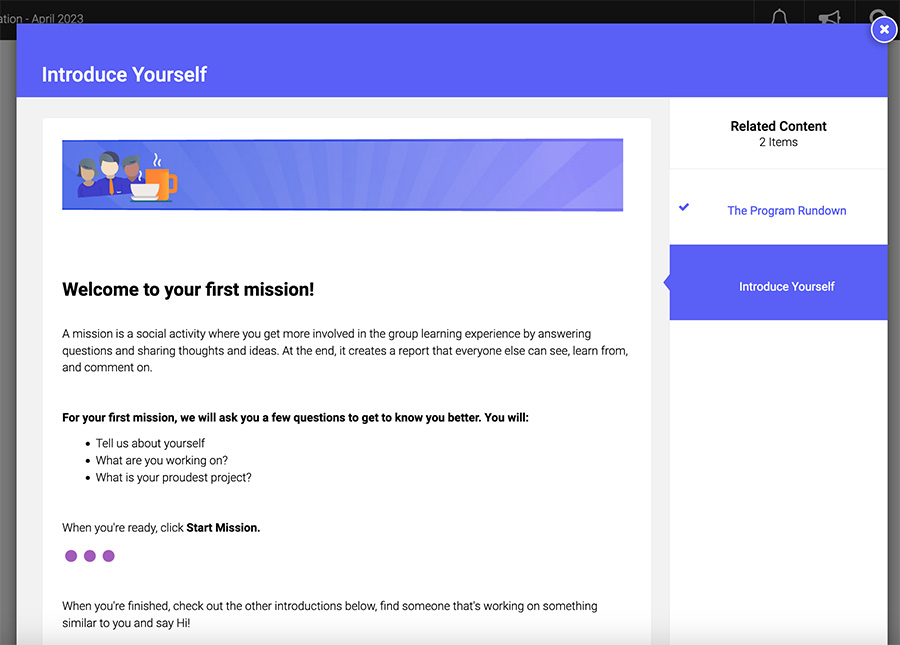
An example of an “Introduce Yourself” Mission.
2. Promote growth opportunities within organization and role
Research tells us that when career growth opportunities align with expectations, knowledge workers don’t just work – they thrive, forging deeper ties with their organizations. This bond translates to enhanced employee retention.
The foundation of this bond begins with cultural immersion and a strong focus on organizational values. When employees see the company’s vision aligning with their aspirations, it fosters deep commitment. It’s no longer just about acquiring skills or climbing the ladder. It’s about being part of a story, weaving the values and missions of the organization into one’s own career trajectory.
Dedicated avenues for role readiness and professional development also strengthen an employee’s commitment. Clear pathways to role proficiency and future growth opportunities on the front lines signal mutual respect. It conveys the message: “We recognize your potential and are here to support your growth.”
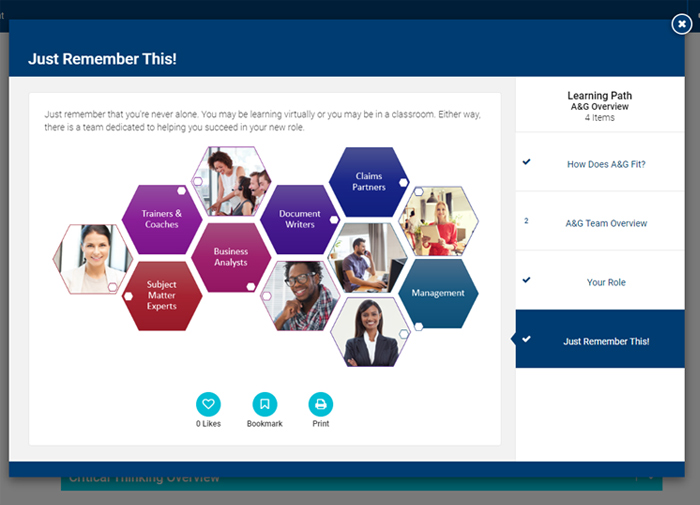
UnitedHealthcare’s award-winning Medicare Appeals & Grievances healthcare onboarding program has a strong focus on ongoing support, collaboration, and feedback through its entirety to help new hires grow and succeed within the organization.
3. Facilitate peer connections through a “learning buddy” system
In the dynamic landscape of professional development, fostering peer connections is a strategic move that goes beyond traditional mentorship. Introducing a ‘learning buddy’ system during the onboarding process can significantly enhance the new hire experience. Unlike mentors, learning buddies are often peers or professionals at a similar or slightly higher level, creating a collaborative learning environment where knowledge flows freely in both directions.
The value of collaborative learning lies in its ability to cultivate a culture of shared insights and mutual growth. Pairing new hires with colleagues who may be at an equal or slightly advanced career stage encourages the exchange of diverse perspectives and skills. For example, envision a scenario where a junior developer is paired with a colleague who has recently navigated a similar learning curve. This relationship allows the new hire to benefit from the seasoned professional’s experiences, while the experienced colleague gains fresh insights and perspectives from the newcomer’s innovative approach.
Moreover, embedding social and collaborative learning into onboarding isn’t just a nice-to-have—it’s a proven driver of stronger engagement, higher retention, and a deeper sense of belonging from day one. As discussed in “Ditch the Slide Decks: Bring Social Learning Into Onboarding,” replacing passive learning formats with interactive, peer-driven experiences like buddy systems can make onboarding far more impactful. Instead of relying solely on lectures or static materials, creating structured opportunities for new hires to connect, share, and learn together sets the stage for long-term success.
The ‘learning buddy’ system not only accelerates the onboarding process but also lays the foundation for an ongoing culture of collaborative learning within the organization, fostering continuous professional development for all employees.
Peer connection becomes even more important in remote or distributed onboarding, where new hires have fewer opportunities for spontaneous interactions. Buddy systems, cohort discussions, collaborative activities, and peer feedback can create intentional opportunities to ask questions, exchange experiences, and build relationships across locations.
4. Prioritize ruthless relevance with action-oriented learning content
Ruthless relevance in learning hinges on content that immediately connects with a learner’s day-to-day tasks and challenges, ensuring that what they engage with is directly applicable and impactful in their work. Without clear objectives, new hires may find themselves adrift in a sea of information. In this age of digital content overload, the last thing they need is another listless journey through generic modules.
Send the learner out into the field to learn from others, find information on company sites, learn about customers, and solve realistic problems. Ask them to “go do” rather than just read stuff passively. In Intrepid, new hires can practice and apply skills through real-world assignments, projects, roleplays, simulations, and other activities, then improve through feedback from AI, peers, or experts.
When UnitedHealthcare redesigned one of its onboarding programs to focus on applied learning, they saw average NPS scores increase from 35% to 72% and a shortening of time-to-proficiency from nine months to six weeks. It’s a win-win for both the employee and organization.
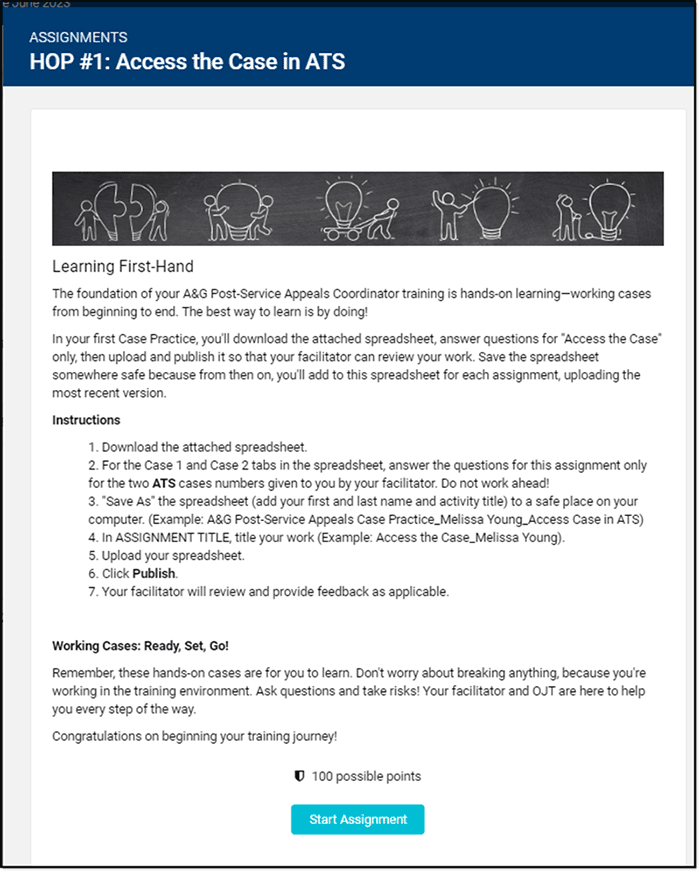
Here’s a sample of one of UnitedHealthcare’s case practice assignments in Intrepid for learners to complete, with gamification incorporated in the form of points earned to increase learner motivation and engagement.
5. Use an employee onboarding platform to create a connected experience
A fragmented onboarding experience creates unnecessary friction. New hires may find themselves moving among an LMS, video meetings, documents, messaging apps, email, practice tools, and other systems just to understand what they’re supposed to learn or do next.
An employee onboarding platform can help create a more connected experience by bringing learning activities, resources, communication, practice, collaboration, and progress visibility into a structured journey. That doesn’t necessarily mean replacing your existing LMS or HR technology. A learning platform can work alongside those systems to provide richer opportunities for new hires to learn, practice, and build proficiency.
What should you look for in an employee onboarding platform?
Depending on your onboarding goals, useful capabilities may include:
- Structured learning journeys that guide employees through onboarding
- Real-world practice and application
- Feedback from managers, peers, experts, or AI
- Peer collaboration and connection
- Automated communications and reminders
- Progress and proficiency measurement
- Gamification and recognition
- Integrations with existing LMS, HR, SSO, analytics, and business systems
- The ability to scale across roles, cohorts, locations, and regions
For global onboarding, also consider localization, governance, flexible scheduling, and the ability to maintain a consistent experience while adapting learning for different roles and regions.
6. Use spaced learning principles to spread good onboarding practices out over time
Spaced learning taps into our brain’s innate rhythm, enhancing memory and skill acquisition through well-timed intervals. This approach, which is part of the AGES model, particularly shines when combined with “on-the-field” activities, allowing practical application to reinforce theoretical understanding.
Create a time-released learning experience that spaces learning over time, encouraging steady learner engagement and steering away from last-minute cram sessions. Tactics like spaced quizzes, automated email reminders, and ongoing projects or missions encourage ongoing participation, reinforcing crucial concepts and skills.
In our previously mentioned employee onboarding case study, for instance, the spaced learning approach led to consistent engagement, a reduction in onboarding time, enhanced instructor productivity, worldwide training accessibility, and accelerated role adoption, collectively contributing to successful onboarding outcomes. Organizations can use this principle to enhance traditional training, creating a dynamic onboarding process that seamlessly blends theory with practice for lasting impact.
Streamlining onboarding shouldn’t mean squeezing more information into fewer days. Prioritize what employees need at each stage, give them opportunities to retrieve and apply it, and reinforce important knowledge and skills as they begin doing the work.
7. Use gamification to motivate progress and practice
Gamified onboarding uses game mechanics—such as points, badges, progress indicators, challenges, milestones, and leaderboards—to encourage new hires to participate and progress through the onboarding experience.
Who doesn’t enjoy a good challenge, especially when it’s wrapped up in an exciting game format? Integrating gamified elements into onboarding can be the key to supercharging learner motivation. When learning becomes an interactive quest, it engages the mind, triggers curiosity, and and motivates new hires to actively participate and achieve milestones.
Game mechanics like points, levels, a leader board, and badges offer immediate feedback and visual milestones, serving as compelling reminders of progress. So, consider integrating interactive challenges and gamification into your onboarding journey to transform the mundane into the memorable with an engaging and positive tone.
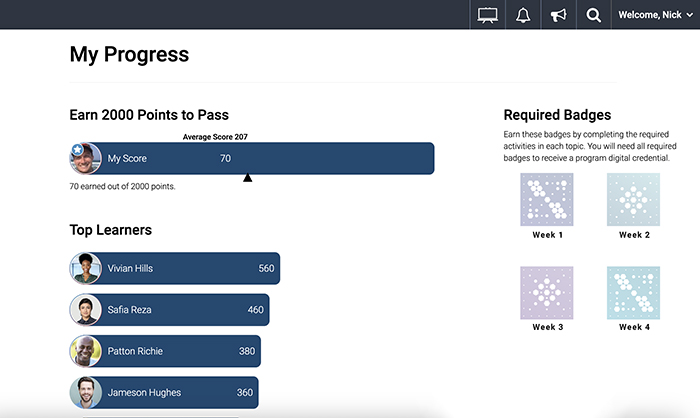
An example of a leader board and badges within Intrepid to engage and motivate new hires to participate and achieve milestones.
The key is to connect gamification to meaningful behaviors rather than adding points simply to make training feel like a game. For example, new hires might earn recognition for completing a realistic practice scenario, collaborating with a peer, reaching a learning milestone, or demonstrating proficiency.
What tools can create gamified onboarding experiences?
Learning and employee onboarding platforms can support gamification through capabilities such as points, badges, leaderboards, progress tracking, challenges, assessments, and social recognition. Intrepid, for example, supports gamification alongside applied learning activities, allowing organizations to connect game mechanics with practice, collaboration, and skill development.
When evaluating gamified onboarding tools, consider more than the number of game mechanics available. Look at whether gamification supports the behaviors and outcomes you’re trying to encourage and whether you can measure progress toward actual proficiency.
8. Use data-driven insights to refine the employee onboarding process
The idea of measuring workplace learning early in the onboarding process may seem odd – after all, shouldn’t we focus on just welcoming new hires rather than assessing them? Yet, while initial warmth is vital, a deeper understanding from the get-go sets the stage for success.
Data-driven insights offer a precise lens to gauge the effectiveness of employee onboarding strategies. By monitoring learner progress and interactions with course content, filtering against key metrics like time-to-competency, and getting granular insights at cohort and individual levels, companies can pinpoint areas for enhancement and ensure every employee feels competent and connected from day one.
Onboarding measurement can also go beyond content interactions and completion. Practice activity, assessment performance, learner feedback, and other signals can help organizations understand where new hires are progressing, where they’re struggling, and where additional coaching or reinforcement may be needed.
For skill-intensive roles, that shifts the question from “Did they finish onboarding?” to a more useful one: “Are they ready to do the job?”
Combat onboarding challenges by meeting a new hire’s “5 Moments of Need”
While good onboarding practices set the tone, it’s the real-time, in-the-moment support that truly resonates with new hires and addresses their day-to-day challenges. Conrad Gottfredson and Bob Mosher’s “5 Moments of Need” framework provides a lens through which this support can be structured:
- New: Imagine the first-day jitters of a new customer service agent. Amidst the excitement, they dive into a comprehensive onboarding session to understand their new role. The challenge amplifies when onboarding remote employees, but a tailored virtual experience ensures their success. Engaging digital modules, community forums, and instant access to reference tools keep them closely connected with the company’s essence.
- More: Curiosity can steer us toward further understanding. Say an HR professional wishes to refine recruitment strategies. Anticipating this need, the company should stand ready with advanced resources or mentoring sessions that enrich their understanding, helping them master nuances beyond the basics.
- Apply: When it’s time to implement newfound knowledge, real-world application is key. Practice activities such as roleplays, simulations, real-world assignments, and AI-supported feedback can give employees a lower-stakes environment to apply new skills before they need to demonstrate them independently on the job.
- Solve: Challenges are an inevitable part of the journey. When a marketing executive encounters a hiccup not covered during onboarding, they can rely on readily available troubleshooting guides or seek assistance from peer forums. This immediate support helps overcome hurdles and transforms them into valuable learning opportunities.
- Change: As the corporate landscape evolves, adaptability isn’t just a virtue – it’s a necessity. With changes in company policy or the introduction of new tools, timely update sessions or micro-modules can bridge the knowledge gap and keep every team member in the loop.
Key takeaways: a roadmap for onboarding best practices
Effective employee onboarding isn’t a one-time orientation or checklist. It’s a structured path from new hire to capable, confident contributor.
The strongest onboarding strategies combine clear expectations with relevant learning, real-world practice, peer connection, feedback, reinforcement, and measurement. The right technology can help organizations deliver those experiences consistently at scale while giving learning teams and managers greater visibility into employee progress.
Ultimately, the measure of effective onboarding isn’t simply whether employees completed it. It’s whether they’re prepared to perform.
Are you seeking a learning solution that seamlessly integrates the best onboarding practices with the latest technology? With Intrepid’s collaborative learning platform, new hires are empowered, swiftly integrated, and immersed in your company’s ethos from day one.
Book a demo and enhance your onboarding approach, ensuring a transformative first experience that will build the foundation for motivated, productive, and retained employees.
Frequently asked questions about onboarding best practices
What is employee onboarding?
Employee onboarding is the strategic process through which new hires seamlessly integrate into a company. It lays the foundation for a new hire’s transition into their job role, work processes, relationships, and company culture.
What are employee onboarding best practices?
Eight onboarding best practices to enhance the employee experience include:
- Extend a heartfelt welcome to new employees
- Promote growth opportunities within organization and role
- Facilitate peer connections through a “learning buddy” system
- Prioritize ruthless relevance with action-oriented learning content
- Centralize onboarding resources for easy access and efficiency
- Use spaced learning principles to spread good onboarding practices out over time
- Boost employee engagement through gamification
- Use data-driven insights to refine the employee onboarding process
Why is onboarding considered crucial for employee retention?
Onboarding shapes some of an employee’s earliest experiences with their role, manager, colleagues, and organization. A strong onboarding process can create greater clarity, connection, confidence, and engagement, while a poor experience can leave new hires feeling isolated or unprepared. Onboarding is only one factor affecting retention, but it can establish an important foundation for an employee’s longer-term experience.
What are the benefits of a good onboarding process?
A good onboarding process can accelerate time-to-proficiency, improve role readiness and confidence, strengthen employee connection and engagement, create more consistent experiences across teams, and give organizations greater visibility into where new hires are succeeding or need additional support.
What tools or platforms can enhance employee onboarding?
Employee onboarding can be supported by HR systems, learning management systems, learning platforms, communication and collaboration tools, knowledge bases, and specialized onboarding software. The right technology depends on the problem you’re trying to solve. For organizations focused on building employee capability, learning platforms such as Intrepid can add real-world practice, collaboration, feedback, and progress toward proficiency to the onboarding experience.
Can you recommend tools for creating gamified onboarding experiences?
Look for learning and employee onboarding platforms that support capabilities such as points, badges, leaderboards, progress tracking, challenges, assessments, and social recognition. Intrepid combines gamification with applied learning activities so organizations can reinforce practice, collaboration, progress, and skill development throughout onboarding.
What features should I look for in an employee onboarding platform?
Look for capabilities that support structured learning journeys, real-world practice, personalized feedback, peer collaboration, automation, analytics, gamification, integrations, and enterprise scale. For skill-intensive roles, also consider whether the platform can help you understand proficiency and readiness rather than only tracking onboarding completion.