

Onboarding is still a significant point of failure in the employee experience. According to a recent report by Brandon Hall Group™, improving new employee onboarding was a top three priority for improving the employee experience. Organizations in all sorts of industries still regularly drop the ball from a basic logistics standpoint (e.g. no device, no ID card etc.) or deliver ineffective or inefficient onboarding training that lengthens time to efficiency or even worse leaves employees ill-prepared to succeed.
Healthcare onboarding failures carry even higher stakes. Whether it’s a patient calling about test results or a member navigating insurance benefits, first impressions with frontline staff directly impact trust, satisfaction, and outcomes—yet most organizations in these sectors still take nearly a year to fully onboard their member and patient-facing employees.
The consequences are amplified in these critical industries. High-turnover roles require speed-to-proficiency with zero margin for error, while current approaches leave dangerous gaps in readiness and confidence. But leading healthcare and health insurance organizations are finding a better way, achieving dramatic transformations that slash onboarding time by 83%.
Key Takeaways
- Healthcare and health insurance organizations struggle with outdated onboarding processes that slow proficiency, drain resources, and risk patient and member trust.
- Common challenges include fragmented training systems, heavy reliance on manual coaching, lack of safe practice, inconsistent readiness across teams, and workforce shortages that amplify skill gaps.
- Leading organizations are cutting onboarding time by up to 83% using collaborative, AI-powered, practice-first programs that deliver faster confidence, consistent quality, and measurable impact.
The Problem: Why Traditional Healthcare Onboarding Falls Short
The stakes couldn’t be higher for member and patient-facing roles. For healthcare providers, patient satisfaction directly impacts Hospital Consumer Assessment of Healthcare Providers and Systems (HCAHPS) scores and reputation. For health insurance organizations, member experience affects retention and Net Promoter Scores. Yet most organizations still rely on outdated healthcare onboarding approaches that create significant pain points:
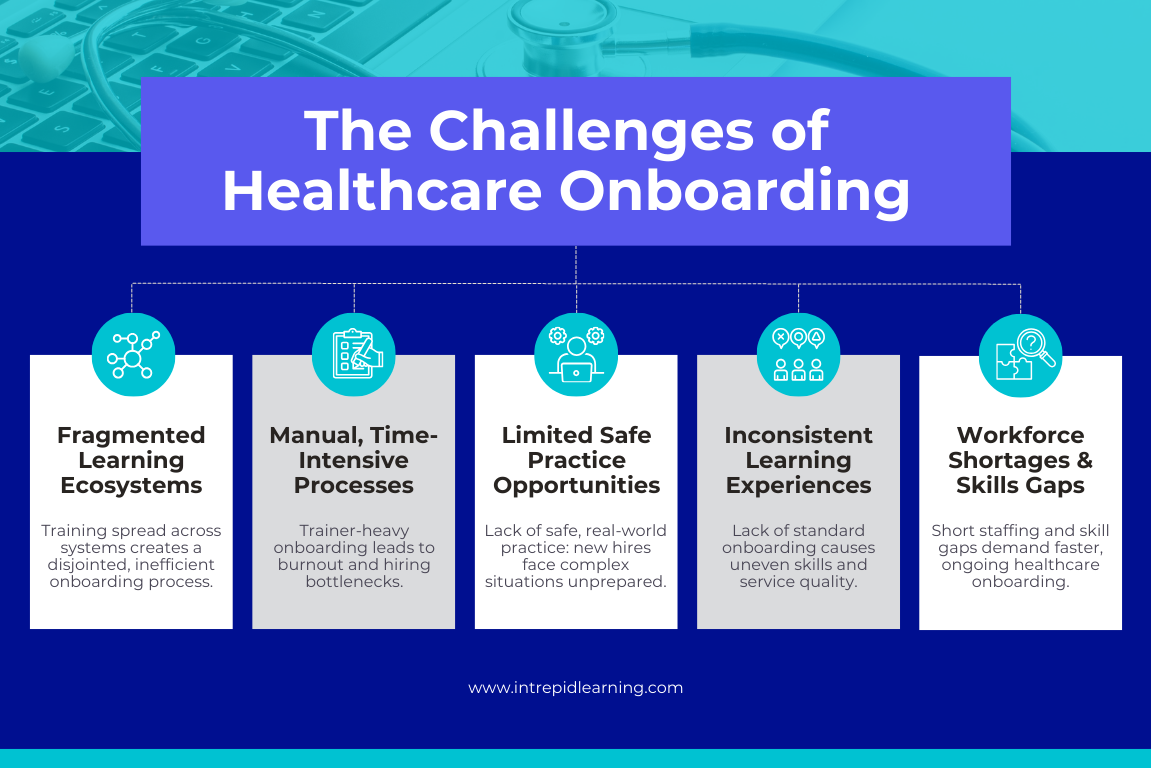
Fragmented Learning Ecosystems
Training is scattered across LMS platforms, classroom sessions, and job shadowing, creating a disjointed experience with no centralized strategy. Many organizations lack healthcare onboarding software that can unify these disparate elements into a cohesive experience.
Manual, Time-Intensive Processes
Heavy reliance on trainer availability and one-on-one coaching creates bottlenecks. With trainer burnout and workforce shortages, this approach simply doesn’t scale during peak hiring periods.
Limited Safe Practice Opportunities
New hires memorize policies and procedures but lack real-world application before going live with members or patients. They’re expected to perform complex interactions without adequate practice in a safe environment.
Inconsistent Experiences
Training quality varies dramatically across departments, shifts, vendor partners, and subsidiary organizations, leading to unpredictable readiness levels and service quality. Without standardized healthcare provider onboarding best practices and processes, organizations struggle to maintain quality control.
Workforce Shortages and Skill Gaps
The healthcare industry faces critical staffing shortages while simultaneously requiring continuous upskilling as regulations, technologies, and care models evolve rapidly. Traditional annual training cycles can’t keep pace with weekly skill development needs.
Industry-specific challenges compound these issues. Healthcare providers must navigate clinical protocols, patient safety requirements, and HIPAA compliance. Health insurance organizations face coverage complexities, claims processing procedures, and Annual Enrollment Period readiness demands. The ripple effect is costly: extended ramp times hurt productivity and service quality, trainer burnout increases, and organizations lack visibility into actual readiness and competency development.
The Real Cost: Why Slow Onboarding Hurts More Than Your Training Budget
The financial and operational impact of slow or ineffective onboarding goes well beyond the training department. Longer ramp times drive up per-hire costs in industries already operating on thin margins — and those delays have a direct ripple effect on revenue. For healthcare providers, every point drop in HCAHPS scores can mean lower reimbursement rates and reduced patient trust. For health insurance organizations, an underprepared frontline means more member churn, missed upsell opportunities, and a dent in Net Promoter Scores (NPS).
The impact shows up in day-to-day operations as well. Low confidence and inconsistent readiness extend average handle times, reduce first-call resolution rates, and create more callbacks — all of which inflate service costs. Trainer burnout and resource constraints slow down hiring cycles, while seasonal surges like flu season or Annual Enrollment Period (AEP) magnify these bottlenecks. A delay of even a few minutes per patient encounter or claim call, multiplied across thousands of interactions, adds up to a substantial loss in both productivity and customer goodwill.
Strategically, slow onboarding erodes organizational agility. Teams can’t pivot quickly when new regulations drop, when technology platforms change, or when service models evolve toward digital-first experiences. This lag not only puts organizations behind more nimble competitors but also limits their ability to seize growth opportunities, respond to member needs, and meet compliance requirements without disruption.
In short: ineffective onboarding isn’t just a training issue — it’s a performance, revenue, and competitive positioning issue.
The Shift: How Healthcare Leaders Are Elevating Onboarding
At Intrepid, we’ve seen first-hand that fixing onboarding in healthcare and health insurance requires more than digitizing old processes — it demands a practice-first, collaborative approach that directly addresses the most persistent pain points: lack of safe practice opportunities, limited facilitation resources, and inconsistent experiences.
Our collaborative learning platform enables organizations to put realistic member and patient interaction scenarios at the center of onboarding. Learners can engage with these scenarios in multiple ways — live role-plays, group activities, quizzes, projects, and now, our new AI Activity. With AI in learning, employees can practice situations like a benefits explanation call or a patient intake conversation, receiving instant, personalized feedback via text or voice. The AI adapts in real time to their responses, offering almost limitless possibilities for realistic, role-specific practice.
But AI and practice are only part of the story. Intrepid’s foundation is built on collaboration — a proven driver of performance improvement. Peer-to-peer learning, discussion forums, and team-based missions break down silos and ensure knowledge isn’t trapped in a single department or shift. In our experience, organizations that integrate collaborative learning into onboarding see significant boosts in learner engagement, knowledge retention, and overall readiness.
Across both healthcare providers and health insurance organizations, our customers are using these capabilities to:
- Give clinical staff a safe space to practice patient communication and compliance scenarios
- Enable administrative teams to work through insurance verification processes together
- Prepare member service reps to handle complex coverage or claims questions
- Build confidence in HIPAA compliance, de-escalation, and system navigation skills
UnitedHealthcare: Modern Onboarding for Faster, More Confident Teams
One of our most compelling success stories demonstrates exactly how this approach transforms healthcare onboarding at scale.
Challenge
UnitedHealthcare’s Medicare Appeals & Grievances (A&G) team faced an onboarding challenge common in complex healthcare roles:
- Time-to-proficiency was nine months, delaying productivity for new hires
- Learners struggled to apply training to real cases, leading to inconsistent performance
- The existing onboarding model was difficult to scale for thousands of employees worldwide while keeping quality consistent
Solution
Partnering with Intrepid, UnitedHealthcare implemented a cohort-based, collaborative learning program grounded in the 5 Moments of Need framework. The program replaced passive training with:
- Real case simulations — learners worked through complete case files per module to mirror actual job tasks
- Live training environments for applied practice
- Peer collaboration and feedback loops to reinforce skills
- A scalable virtual delivery model, ensuring consistency across global locations
Results
- Time-to-proficiency reduced from nine months to six weeks
- Net Promoter Score (NPS) improved from ~35 to ~72
- Supervisors reported new hires outpacing some tenured staff in both confidence and accuracy
- Successfully onboarded thousands of employees across the globe in a fully virtual environment
- Earned industry recognition for innovation in onboarding design
Now, we’re taking this approach to the next level with our AI Activity feature. By enabling adaptive, AI-driven practice scenarios — such as simulated member calls or patient intake conversations — we make it possible to provide unlimited, role-specific skill building without overburdening trainer resources. For any healthcare or health insurance organization that understands how critical practice is to building skills, a feature like this can supercharge onboarding programs, accelerating confidence, improving readiness, and delivering measurable performance gains.
Across our customer base, results from modern, collaborative onboarding speak for themselves. Organizations report significantly reduced onboarding cycle times, improved learner satisfaction scores, and trainer resources freed to focus on high-value coaching instead of basic information delivery. The outcome is clear — faster skill development, higher confidence, and more agile organizations ready to meet the demands of an evolving industry.
The Opportunity: 5 Steps L&D Teams Can Take Now
Transforming onboarding in healthcare and health insurance doesn’t have to mean a multi-year overhaul. By following a structured approach, L&D teams can make measurable improvements now while laying the groundwork for longer-term change. Here’s a 5-step healthcare onboarding checklist to get started:
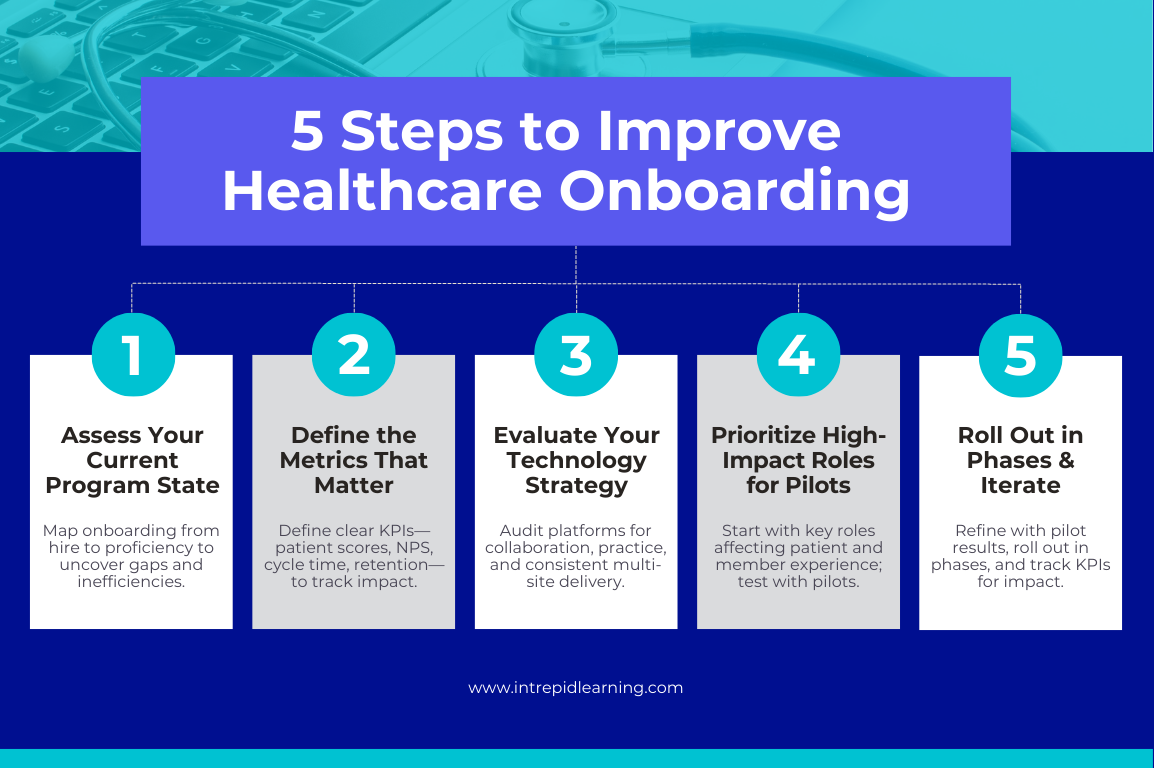
1. Assess Your Current State
Begin with a thorough review of your onboarding program for member- and patient-facing roles. Map the entire journey from offer acceptance to full proficiency, documenting every training touchpoint. Look for gaps in practice opportunities, inconsistencies between locations or shifts, and areas where trainer capacity is a bottleneck. This baseline will reveal where effort will have the biggest impact.
2. Define Success Metrics That Matter
Establish clear, role-specific KPIs before making changes. For healthcare providers, this may include patient satisfaction (HCAHPS) scores, time-to-competency for critical clinical skills, and clinical quality indicators. For health insurance organizations, key metrics often include member NPS, first-call resolution rates, and readiness for Annual Enrollment Period (AEP). Across both sectors, track trainer efficiency, onboarding cycle time, and new hire retention rates to measure business impact.
3. Evaluate Your Technology Strategy
Audit your current learning platforms for their ability to support collaborative learning, role-specific practice, and consistent delivery across multiple locations and shifts. Consider investing in specialized healthcare onboarding software that can handle sector-specific complexity while supporting the healthcare onboarding best practices outlined above. Ensure integration plans cover existing HRIS, compliance, and quality management systems so the onboarding experience is seamless for learners and admins alike.
4. Prioritize High-Impact Roles for Pilots
Focus your initial efforts on roles with the greatest influence on member and patient experience — for example, call center agents, patient intake coordinators, or front-line clinical staff. Redesign the healthcare provider onboarding journey for these positions using collaborative, practice-first methods that follow healthcare onboarding best practices, then run a small pilot cohort. Include a mix of departments and shifts to test for scalability.
5. Roll Out in Phases and Iterate
Use pilot results to refine your approach before expanding. Phased rollouts help maintain quality and allow you to make adjustments based on real-world feedback. Continue measuring your defined KPIs throughout, and use insights to further tailor content, technology use, and facilitation methods for maximum impact.
Conclusion
Healthcare and health insurance onboarding doesn’t have to take most of a year. Leading organizations across both industries are achieving dramatic results through modern approaches that prioritize speed, consistency, and improved member and patient experiences. The competitive advantage of rapid, effective onboarding becomes increasingly important as both sectors undergo digital transformation and face growing expectations for service excellence.
Member and patient experience serves as a key differentiator in both healthcare and health insurance, making onboarding transformation not just an operational improvement but a strategic imperative. Organizations that embrace collaborative, AI-supported, practice-based onboarding position themselves for success in an increasingly competitive landscape.
Ready to see how leading healthcare and health insurance organizations are transforming onboarding? Get a healthcare-specific demo to explore what’s possible, or learn the complete UnitedHealthcare transformation story to see proven results in action.
For more healthcare learning transformation insights, explore additional resources including proven approaches to reimagining L&D in healthcare and transforming learning with industry leaders.
Frequently Asked Questions About Healthcare Onboarding
What is onboarding in healthcare?
Onboarding in healthcare is the process of preparing new member- and patient-facing employees to perform their roles confidently and compliantly. It includes training on clinical protocols, patient communication, HIPAA requirements, insurance procedures, and customer service skills. Effective onboarding ensures faster proficiency, consistent quality, and better patient and member experiences.
What are the strategies for the successful onboarding of healthcare employees?
Successful healthcare onboarding requires moving beyond outdated, fragmented approaches. Leading organizations focus on:
- Standardizing experiences across departments, shifts, and global locations
- Providing safe, role-specific practice opportunities with real-world scenarios
- Reducing reliance on manual coaching through scalable digital delivery
- Using collaborative, cohort-based learning to boost engagement and retention
- Applying AI-driven activities for adaptive, personalized skill building